Credit Cards With No Annual Fee and Cash Back: Best Options in 2026
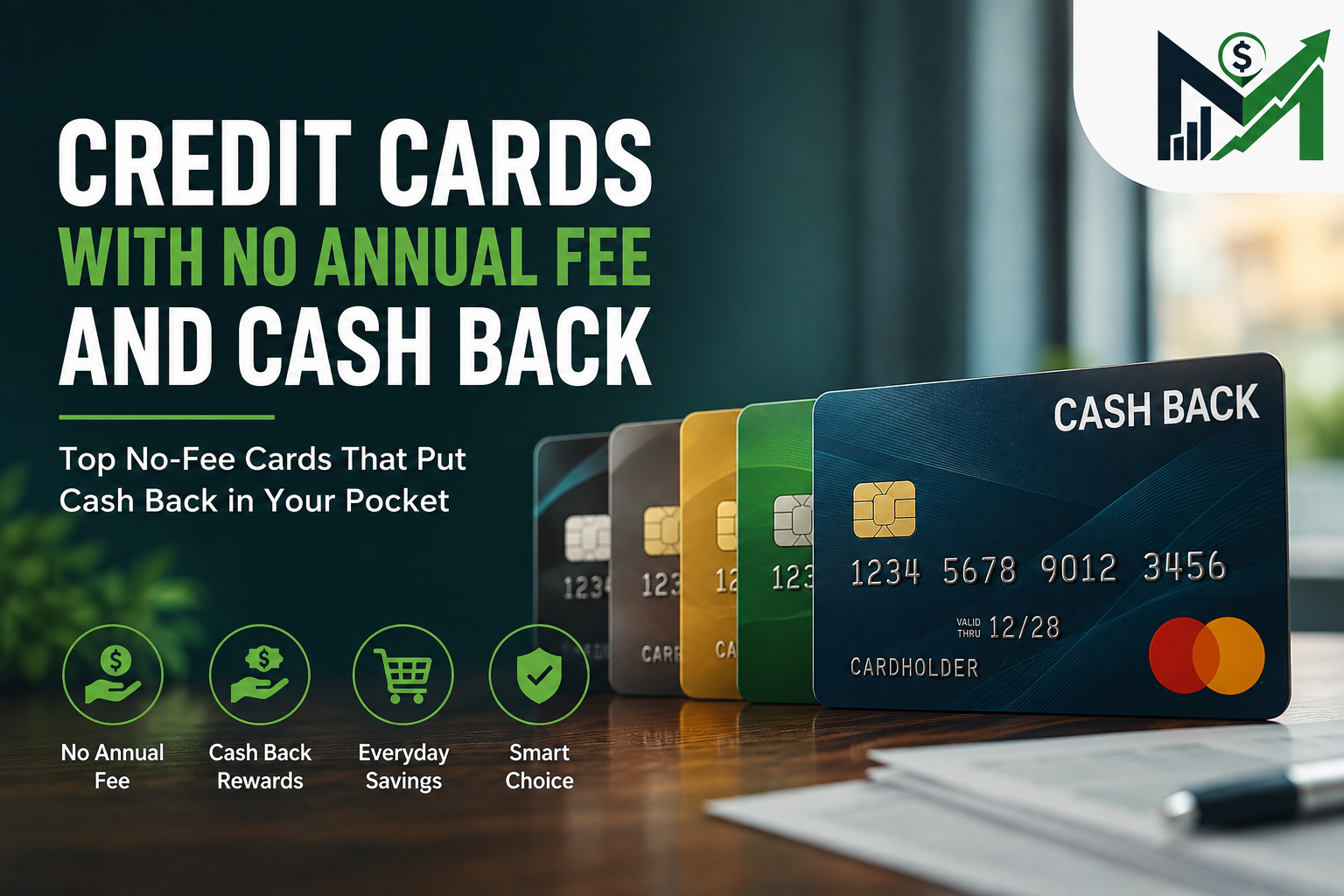
If you want to earn money back on everyday purchases without paying a yearly card fee, credit cards with no annual fee and cash back can be an excellent choice. These cards allow you to earn rewards on purchases such as groceries, dining, gas, travel, streaming services, and everyday shopping while avoiding the recurring cost of an annual fee.
The challenge is that not every cash-back card works the same way. Some offer a simple flat rate on every purchase, while others provide higher rewards in specific categories. Some also offer introductory bonuses or promotional rewards that can significantly increase their first-year value.
As of 2026, several strong options are available, including the Citi Double Cash, Wells Fargo Active Cash, Chase Freedom Unlimited, Capital One Savor, Discover it Cash Back, and Bank of America Customized Cash Rewards. The right card ultimately depends on where you spend the most money, how much complexity you are willing to manage, and whether you regularly pay your balance in full.
What Is a No-Annual-Fee Cash-Back Credit Card?
A no-annual-fee cash-back credit card is a rewards credit card that does not charge a recurring annual fee while giving you a percentage of eligible purchases back as rewards.
For example, if a card offers 2% cash back and you spend $1,000 on eligible purchases, you could earn $20 in rewards.
The basic calculation is:
Cash back = Eligible spending × Cash-back rate
So:
- $500 × 1% = $5
- $1,000 × 2% = $20
- $2,000 × 3% = $60
- $5,000 × 2% = $100
The important part is understanding that a higher advertised rate does not necessarily mean a card will give you more money overall. A 5% category bonus with a spending cap may be less valuable to you than an unlimited 2% card if most of your purchases fall outside the bonus category.
Cash-back cards are generally straightforward because you are earning a reward with a relatively easy-to-understand value. However, rewards only make financial sense when the card is used responsibly. Carrying a balance and paying substantial interest can easily outweigh the cash back you earn.
Best Credit Cards With No Annual Fee and Cash Back in 2026
Here are some of the strongest options to consider based on different spending patterns.
| Credit Card | Annual Fee | Main Cash-Back Structure | Best For |
|---|---|---|---|
| Citi Double Cash | $0 | Unlimited 2% on purchases | Simple everyday spending |
| Wells Fargo Active Cash | $0 | Unlimited 2% | Flat-rate cash back + intro offer |
| Chase Freedom Unlimited | $0 | 1.5% base, 3% dining/drugstores, 5% Chase Travel | Flexible everyday spending |
| Capital One Savor | $0 | 3% groceries, dining & entertainment; 1% other purchases | Food and entertainment |
| Discover it Cash Back | $0 | 5% rotating categories when activated, 1% other purchases | Category optimizers |
| Bank of America Customized Cash Rewards | $0 | 3% chosen category, 2% grocery/wholesale clubs, 1% elsewhere | Category-based spending |
Rates, rewards categories, limits and introductory offers can change, so applicants should verify the current terms before applying.
1. Citi Double Cash Card
The Citi Double Cash Card is one of the simplest choices for someone who does not want to think about rotating categories.
It currently offers unlimited 2% cash back on purchases, structured as 1% when you make the purchase and another 1% as you pay. The card has no annual fee, and there are no category enrollments or spending caps for its standard 2% purchase reward.
That makes it particularly attractive for people who spend across many different categories.
For example, suppose your annual spending looks like this:
- Groceries: $5,000
- Utilities and bills: $4,000
- Shopping: $4,000
- Transportation: $3,000
- Other purchases: $4,000
With $20,000 in eligible spending at an effective 2% rate, you could earn approximately $400 in cash back.
Citi also currently advertises a $200 cash-back offer after spending $1,500 within the first six months, subject to the offer’s terms.
Best for: People who want a simple, flat-rate cash-back strategy.
Potential drawback: Specialized cards can earn more in specific spending categories.
2. Wells Fargo Active Cash Card
The Wells Fargo Active Cash Card is another strong flat-rate option.
It offers unlimited 2% cash rewards on purchases, carries a $0 annual fee, and currently advertises a $200 cash rewards bonus after spending $500 in purchases during the first three months.
It also currently lists a 0% introductory APR period of 12 months on purchases and qualifying balance transfers, followed by a variable APR. The exact rate you receive depends on your creditworthiness and current terms.
The biggest attraction is simplicity.
You do not have to remember whether restaurants are currently earning 3%, whether a quarterly category needs activation, or whether you have reached a spending cap.
If you put $30,000 of eligible spending on a card earning 2%, that represents $600 in cash rewards, before considering any promotional bonus.
Best for: Consumers who want straightforward 2% rewards on everyday purchases.
Potential drawback: It does not offer the same category-specific earning potential as some specialized cards.
3. Chase Freedom Unlimited
The Chase Freedom Unlimited takes a different approach.
Rather than offering one flat rate everywhere, it combines several reward levels. Current terms include:
- 5% cash back on travel purchased through Chase Travel
- 3% on dining
- 3% at drugstores
- 1.5% on other purchases
There is also no annual fee.
This structure can make the card particularly useful for someone whose spending naturally falls into dining, drugstores and travel. For example, someone who spends heavily on restaurants may earn substantially more than they would with a simple 1.5% flat-rate card.
The important distinction is that the 5% travel rate applies to travel purchased through Chase Travel, rather than automatically applying to every travel purchase made elsewhere.
Best for: People who spend regularly on dining, drugstores and Chase Travel.
Potential drawback: If most of your spending falls outside the bonus categories, another 2% flat-rate card may produce more rewards.
4. Capital One Savor
The Capital One Savor is particularly interesting for consumers whose budgets are concentrated around food and entertainment.
The card currently has a $0 annual fee and offers 3% cash back at grocery stores and on dining and entertainment, plus 1% on other purchases. Capital One is also advertising a limited-time $250 cash bonus on the card, subject to the applicable offer terms.
Capital One defines entertainment broadly, making this more than simply a restaurant card. Eligible entertainment can include activities such as movie theaters, sporting events and certain entertainment services.
Consider someone who spends:
- $6,000 on groceries
- $3,000 on dining
- $2,000 on entertainment
- $9,000 on other purchases
The first $11,000 in the listed 3% categories could generate about $330 in cash back, while the remaining $9,000 at 1% would generate another $90, for approximately $420 in category rewards.
Your actual rewards depend on how the merchant is coded and the card’s current reward terms.
Best for: Grocery shoppers, restaurant spenders and people who frequently pay for entertainment.
Potential drawback: Its base rate on non-bonus purchases is only 1%, so it may be weaker as a one-card solution for people with diverse spending.
5. Discover it Cash Back
The Discover it Cash Back is designed for people willing to actively manage their rewards.
It offers 5% cash back on rotating categories when activated, up to the applicable quarterly spending limit, and 1% on other purchases. Discover currently lists a quarterly maximum of $1,500 in combined purchases for the 5% categories.
That means the maximum 5% category spending can produce up to $75 in cash back per quarter:
$1,500 × 5% = $75
If you consistently activate and use the bonus categories, the card can be very rewarding.
Another notable feature is Discover’s Unlimited Cashback Match for the first year. Discover states that it automatically matches the cash back earned during the first year for eligible new cardmembers, with no stated cap on the match.
This can make the first year particularly valuable.
However, there is a catch: you have to pay attention.
If you forget to activate a quarterly category, you generally won’t receive the 5% promotional rate for that category.
Best for: Consumers who enjoy optimizing rewards and tracking quarterly categories.
Potential drawback: Less convenient than an unlimited flat-rate card.
6. Bank of America Customized Cash Rewards
The Bank of America Customized Cash Rewards card is another useful option if you want to choose a category that matches your spending.
The standard structure is:
- 3% in a category of your choice
- 2% at grocery stores and wholesale clubs
- 1% on other purchases
The 3% and 2% rewards are subject to a combined $2,500 quarterly spending limit, after which additional purchases generally earn 1%.
The current new-card promotion is especially notable. Bank of America has been offering enhanced first-year rewards, including 6% in the selected category and 2% at grocery stores and wholesale clubs for the first year, subject to the quarterly limit and applicable terms.
The choice category can include options such as gas and EV charging, online shopping, dining, travel, drugstores, and home improvement and furnishings.
Best for: People whose spending is concentrated in a particular category and who want the flexibility to change their choice.
Potential drawback: The quarterly $2,500 combined cap limits how much spending can receive the elevated rates.
How to Choose the Right Cash-Back Card
The best credit card with no annual fee and cash back isn’t necessarily the card advertising the highest percentage.
Instead, look at your actual spending.
Choose a 2% flat-rate card if:
- You want simplicity.
- Your purchases are spread across many categories.
- You don’t want to track rotating categories.
- You want unlimited rewards without worrying about bonus-category caps.
Cards such as Citi Double Cash and Wells Fargo Active Cash are particularly relevant here.
Choose a category card if:
- You spend heavily on groceries.
- Dining represents a large portion of your budget.
- You spend significantly on entertainment.
- You don’t mind tracking reward categories.
Capital One Savor can make sense for food and entertainment-heavy spending, while Discover and Bank of America offer strategies for category optimization.
Choose a Chase card if:
You regularly spend on dining, drugstores or travel through Chase Travel and can take advantage of its elevated reward rates.
1.5% vs. 2% vs. 3% Cash Back: Does It Really Matter?
It can.
Consider $30,000 of annual spending:
| Cash-Back Rate | Annual Spending | Approx. Annual Rewards |
|---|---|---|
| 1% | $30,000 | $300 |
| 1.5% | $30,000 | $450 |
| 2% | $30,000 | $600 |
| 3% | $30,000 | $900 |
| 5% | $30,000 | $1,500 |
However, this table assumes all $30,000 qualifies for the stated rate.
That rarely happens with category cards.
For example, a card advertising 5% cash back may restrict that rate to certain purchases and impose a quarterly spending limit. After reaching the limit, the reward rate may drop to the standard rate.
Therefore, don’t compare cards solely by their highest advertised percentage.
Compare the effective annual rewards based on your own spending.
Should You Get More Than One Cash-Back Card?
You can, but you don’t necessarily need to.
A two-card strategy can sometimes outperform a single card.
For example, someone could use:
Card 1: A 2% flat-rate card for general purchases.
Card 2: A 3% or 5% category card for groceries, dining, rotating categories or other bonus purchases.
This allows you to use the specialized card where it provides extra value and the flat-rate card everywhere else.
But there is a psychological cost to complexity.
If managing three or four cards causes you to miss payments, overspend or forget which card to use, the theoretical rewards advantage isn’t worth it.
A simple strategy you actually follow can beat a complicated rewards system.
Don’t Ignore the Interest Rate
Cash back should never be an excuse to carry expensive credit-card debt.
Suppose you earn $300 in cash rewards during a year but pay substantially more than $300 in interest because you regularly carry a balance.
In that situation, the rewards strategy is working against you.
For this reason, a good rule is:
Use a cash-back credit card for purchases you can afford to pay off.
The introductory APR can be useful for certain planned purchases or balance-transfer strategies, but promotional periods eventually end. Current card offers can also change, so always read the pricing and terms before applying.
What Credit Score Do You Need?
Many of the strongest cash-back cards are designed for consumers with good to excellent credit.
Bankrate notes that cash-back cards commonly require good credit, with a FICO score around 680 or higher often used as a general benchmark, although issuers use their own approval criteria and a particular score does not guarantee approval.
Your credit score isn’t the only factor.
Issuers may also consider:
- Income
- Existing debt
- Payment history
- Credit utilization
- Length of credit history
- Recent applications
- Number of existing accounts
- Information contained in your credit report
If your credit profile isn’t strong enough for a premium rewards card, a secured or credit-building card may be more appropriate.
Are No-Annual-Fee Cash-Back Cards Really Free?
“No annual fee” does not mean there are no possible fees.
A card can have a $0 annual fee while still charging fees for certain transactions or services, such as:
- Balance transfers
- Cash advances
- Late payments
- Foreign transactions, depending on the card
- Other account services
For example, Citi explicitly notes that although Double Cash has no annual fee, other fees can apply to services such as balance transfers and cash advances.
Therefore, always read the card’s pricing and terms before applying.
Cash Back vs. Points: Which Is Better?
For consumers who want simplicity, cash back is often easier to understand.
If your card earns 2% cash back, you generally know that $100 of eligible spending produces about $2 in rewards.
Points systems can sometimes provide greater value, especially when transferred to travel partners or used for specific redemptions, but they can also require more research.
If your priority is:
“I just want money back on my purchases,”
a straightforward cash-back card may be the better fit.
If you enjoy maximizing travel redemptions and are willing to manage a more complicated rewards system, points-based cards may deserve consideration.
How to Maximize Cash Back Without Overspending
The easiest way to maximize rewards is not to spend more. It is to earn more on spending you were already going to do.
1. Use the right card for the right purchase
If your card offers 3% on dining, use it for eligible restaurant purchases rather than a 1% card.
2. Pay the statement balance in full
Interest can erase your rewards quickly.
3. Track spending caps
A 5% category may have a quarterly limit. Once you’ve reached it, continuing to use that card may no longer produce the advertised rate.
4. Activate rotating categories
With cards such as Discover it Cash Back, failing to activate the quarterly bonus can mean missing the higher reward rate.
5. Don’t chase rewards with unnecessary purchases
Spending $100 unnecessarily to earn $5 in cash back is still losing $95.
6. Consider the welcome bonus
A strong introductory bonus can be worth more in the first year than small differences in the regular cash-back rate.
But never spend money you wouldn’t otherwise spend just to reach a bonus requirement.
Final Verdict
For most consumers looking for credit cards with no annual fee and cash back, the decision comes down to one question: Do you want maximum simplicity or maximum category rewards? If simplicity is your priority, an unlimited 2% cash-back card such as Citi Double Cash or Wells Fargo Active Cash is hard to ignore.
If groceries, dining and entertainment dominate your spending, Capital One Savor may provide more value through its 3% categories. If you enjoy optimizing rotating categories, Discover it Cash Back can deliver higher rewards when you activate and use its 5% categories effectively.
If you want category flexibility, Bank of America Customized Cash Rewards is another option worth examining, particularly because of its current first-year enhanced rewards. And if dining, drugstores and Chase Travel are major parts of your spending, Chase Freedom Unlimited deserves a closer look.
Ultimately, the best card is the one that gives you the highest real-world annual rewards after considering your spending habits, reward caps, fees, introductory offers and interest costs. A no-annual-fee card removes one recurring expense, but the real opportunity is turning purchases you were already planning to make into meaningful cash rewards, without changing your spending habits or carrying expensive debt.
Frequently Asked Questions
Q – What is the best credit card with no annual fee and cash back?
There isn’t one universal winner. Citi Double Cash and Wells Fargo Active Cash are strong choices for straightforward 2% rewards, while Capital One Savor can be more attractive for grocery, dining and entertainment spending. Chase Freedom Unlimited is another option for people who can take advantage of its bonus categories.
Q – Is 2% cash back good?
Yes. An unlimited 2% rate is competitive for a general-purpose cash-back card because it provides a solid reward on purchases without requiring you to track categories.
Q – Is 5% cash back better than 2%?
Not necessarily. A 5% rate may only apply to selected categories and may have spending limits. A 2% unlimited rate can produce more rewards if most of your spending doesn’t qualify for the 5% category.
Q – Do cash-back rewards expire?
It depends on the card. For example, Chase states that its cash-back rewards do not expire while the account remains open.
Always check the individual card’s rewards terms.
Q – Can I have multiple cash-back credit cards?
Yes, depending on the issuer’s approval criteria and your overall credit profile. Using multiple cards can help you earn higher rewards in different spending categories, but managing several accounts requires discipline.
Q – Should I choose cash back or a travel card?
If you want simple rewards that can generally be redeemed as cash or statement credits, cash back is attractive. If you travel frequently and are willing to learn a points system, a travel card may provide additional value.