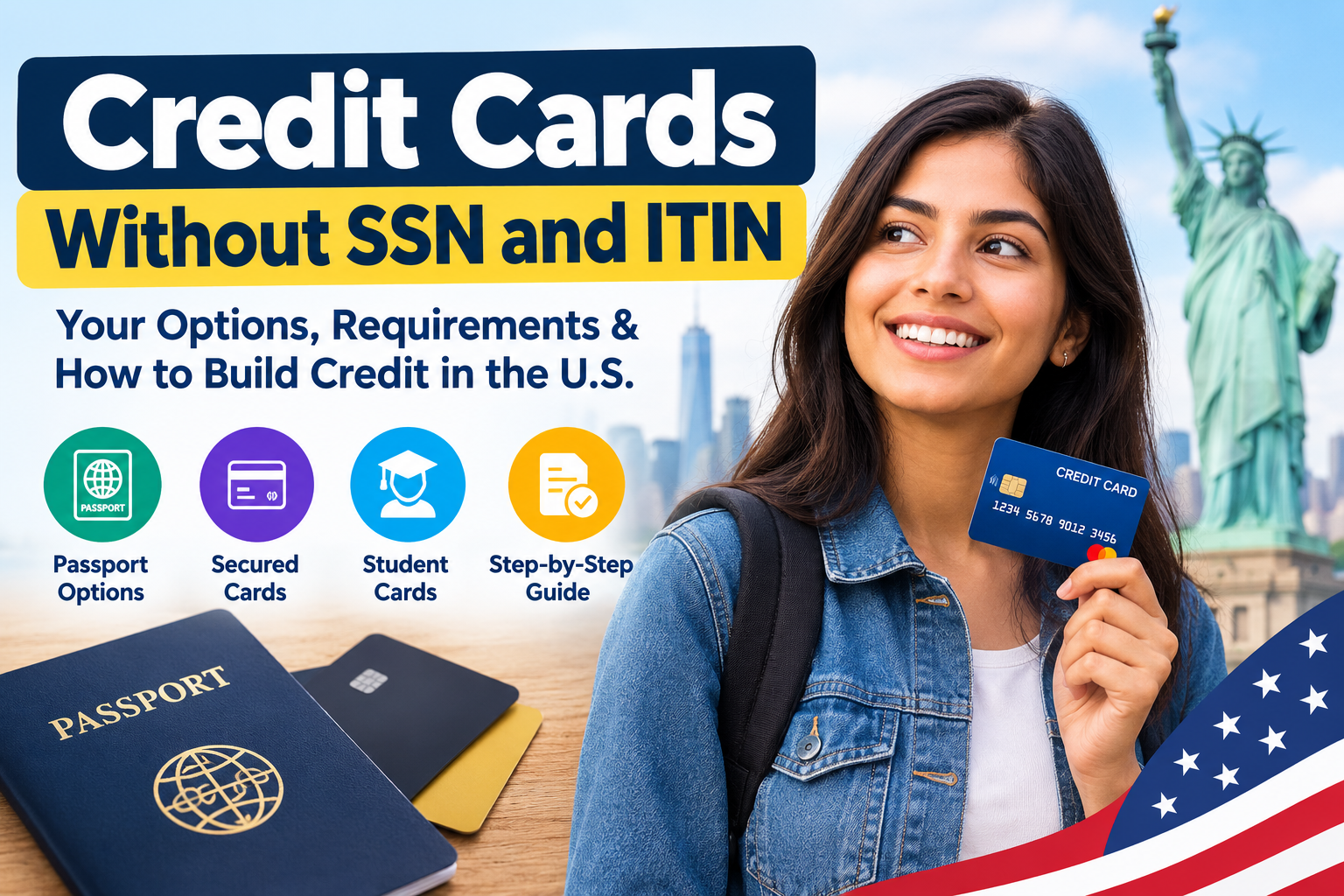
Credit Cards Without SSN and ITIN: What You Can Get in 2026
Getting a credit card in the United States can be difficult if you do not have a Social Security number (SSN) or an Individual Taxpayer Identification Number (ITIN). Many traditional credit card applications ask for one of these numbers as part of the identity and credit-checking process.
However, having neither number does not always mean you have no options.
Some financial products are designed specifically for immigrants, international students, newcomers, and other people who are building a financial life in the United States. A small number of card providers may allow applicants to use alternative identification, such as a passport, while other products may require an ITIN even though they do not require an SSN.
The important thing is to understand exactly what each card requires before applying.
This guide explains how Credit Cards Without SSN and ITIN work, which options may be available, what documents you may need, how secured cards fit into the picture, and what you should do if you cannot qualify for a traditional credit card yet.
Can You Get a Credit Cards Without SSN and ITIN?
Yes, but your options are limited.
Most traditional U.S. credit card issuers request an SSN or ITIN when you apply. Chase, for example, says that most credit card applications require an SSN and/or ITIN. Discover also notes that some immigrants without an SSN may need an ITIN depending on the issuer and product.
That does not mean every credit card requires an SSN.
There are three different situations to understand:
- You have an SSN: You can generally apply for regular U.S. credit cards if you meet the issuer’s other requirements.
- You do not have an SSN but have an ITIN: Some issuers may accept the ITIN instead of an SSN.
- You have neither an SSN nor an ITIN: Your choices become much narrower, but some specialized products and certain student-focused cards may accept alternative identification.
This third category is what people usually mean when they search for credit cards without SSN and ITIN.
The key is not to confuse a card that accepts an ITIN with a card that accepts neither an SSN nor an ITIN.
Why Do Credit Card Companies Ask for an SSN or ITIN?
Credit card companies need to identify applicants and evaluate their ability to repay borrowed money. An SSN is the most common identifier used in U.S. consumer lending. It can help an issuer locate an applicant’s credit file and verify identity.
An ITIN is different.
The IRS issues an ITIN to certain people who need a U.S. taxpayer identification number but are not eligible for an SSN. An ITIN is primarily a federal tax identification number. It is not a replacement for an SSN for every purpose.
Some credit card issuers nevertheless accept an ITIN for credit card applications.
If you have neither number, an issuer has fewer conventional ways to verify your identity and evaluate your U.S. credit history. That is one reason cards designed for international students, immigrants, or newcomers can have different application requirements.
Credit Cards Without SSN and ITIN: Your Main Options
If you have neither an SSN nor an ITIN, there are several routes worth investigating.
1. Specialized Cards That Accept a Passport
The most direct option is a card specifically designed for people who do not yet have an SSN or ITIN.
Some newer financial products allow eligible applicants to use a passport or other identification instead of an SSN.
For example, Firstcard markets a credit-building card for immigrants and says applicants without an SSN or ITIN can apply using a passport. However, availability and eligibility can change, and its current application status should be checked before relying on it.
This type of product can be particularly useful for someone who has recently arrived in the United States and has not yet established a U.S. credit history.
Before applying, check:
- Whether applications are currently open
- Whether your immigration or residency status is eligible
- Whether a U.S. address is required
- Whether a U.S. bank account is required
- Whether the product reports payments to the major credit bureaus
- Whether there is an annual or monthly fee
- Whether a deposit is required
- What identification documents are accepted
Do not assume that a company advertising “no SSN required” automatically means “no SSN and no ITIN required.” Read the current eligibility requirements carefully.
2. International Student Credit Cards
International students may have additional options.
Some student-focused card issuers are designed for people who have recently moved to the United States and may not have an established U.S. credit profile.
Certain student products can use a passport and other information instead of requiring an SSN or ITIN.
This can make them attractive to students on F-1 or other eligible visas. However, eligibility varies considerably. You may be asked for:
- A valid passport
- U.S. residential address
- School information
- Visa information
- Proof of enrollment
- U.S. bank account information
- Proof of income or financial resources
Some products may still require an SSN or ITIN, so international-student status by itself does not guarantee approval.
3. Secured Credit Cards
Secured credit cards are another popular option for people who are new to U.S. credit.
A secured card works differently from a traditional unsecured credit card. You typically provide a refundable security deposit, and the issuer gives you a credit line based partly or entirely on that deposit.
For example, if a card requires a $200 deposit and provides a $200 credit limit, you can use the card for purchases just like a regular credit card. You still have to make your monthly payments.
The deposit is not your monthly payment. It is security for the account. This reduces the issuer’s risk and can make secured cards easier to qualify for than some unsecured cards.
However, there is an important warning for people searching specifically for credit cards without SSN and ITIN:
A secured card does not automatically mean you can apply without an SSN or ITIN.
Many mainstream secured cards still require identification information such as an SSN or may have other eligibility requirements.
For example, Bank of America’s BankAmericard Secured Credit Card currently requires a security deposit of at least $200, with the maximum deposit listed at $5,000. The card is designed to help establish, strengthen, or rebuild credit.
But you should check the issuer’s current application requirements to determine whether you personally qualify without an SSN or ITIN.
4. Credit Cards That Accept an ITIN Instead of an SSN
If you do not have an SSN but you can legally obtain an ITIN, your options become much broader. Some major issuers allow an ITIN to be used instead of an SSN for certain credit card applications. Capital One, for example, explains that some issuers allow applicants to use an ITIN instead of an SSN. Chase similarly explains that credit card applications typically require an SSN and/or ITIN.
This is an important distinction because an ITIN can open doors to products that are unavailable to someone who has neither number. However, you should not apply for an ITIN simply because you want a credit card. An ITIN is issued by the IRS for federal tax purposes. You must meet the IRS eligibility requirements. The IRS says an ITIN is generally for people who need a U.S. taxpayer identification number but are not eligible for an SSN.
How to Get an ITIN
If you qualify for an ITIN, you generally apply using IRS Form W-7. The IRS states that applicants generally submit Form W-7 along with a federal income tax return unless they qualify for an exception. The application also requires documentation proving identity and foreign status. A passport can be an important supporting document because the IRS recognizes it as an identity and foreign-status document under its rules.
However, an ITIN is not simply a number anyone can request for convenience. You need a qualifying reason under IRS rules. For that reason, do not pay someone who promises to “sell” you an ITIN or guarantee that you will receive one. Use the IRS process or an IRS-approved Certifying Acceptance Agent when appropriate.
What Documents Can You Use Instead of an SSN?
The exact documents depend on the issuer. A passport is one of the most common alternatives for people applying for specialized financial products. You may also be asked for:
- U.S. residential address
- Foreign address
- Visa information
- Proof of enrollment
- Employment information
- Income information
- U.S. bank account
- Government-issued identification
- Date of birth
- Phone number
- Email address
The issuer may also perform identity verification using additional information. Having a passport does not guarantee approval. The issuer still has to determine whether you meet its eligibility requirements.
What About Authorized Users?
Becoming an authorized user on someone else’s credit card can be another way to start building a U.S. credit history. An authorized user receives permission to use another person’s credit card account. The primary cardholder remains responsible for the account balance. Depending on the issuer and how the account is reported, the authorized user’s credit report may receive information about the account.
This can potentially help establish credit history. However, you should not assume that every issuer reports authorized-user accounts in the same way. It is also important to choose a primary cardholder who manages the account responsibly. Late payments, high balances, or other negative activity can potentially create problems depending on how the account is reported.
Authorized-user status is therefore not a substitute for having your own credit card forever. It can simply be one possible starting point.
Can You Get a Credit Card With a Passport Only?
Sometimes, but not from most traditional credit card issuers.
A passport-only application is more likely to be found among specialized products aimed at immigrants, international students, or people who are new to the U.S. financial system.
Traditional credit card applications commonly require an SSN or ITIN. Some student-oriented products may have alternative identification procedures. The exact requirements can change, so always check the issuer’s current application page before submitting an application.
If a card claims that you can get approved using “only a passport,” look beyond the headline.
Check whether you also need:
- A U.S. address
- U.S. bank account
- Proof of income
- Student enrollment
- Visa documentation
- A minimum deposit
- A referral
- Specific immigration status
“Passport accepted” does not necessarily mean “passport is the only requirement.”
What Is the Difference Between an Unsecured and Secured Card?
Understanding this difference is important when comparing credit cards.
- Unsecured credit card
An unsecured credit card does not normally require a refundable security deposit. The issuer approves you based on factors such as credit history, income, identity verification, and its underwriting rules. Examples include many standard cash-back, travel, student, and rewards cards.
- Secured credit card
A secured card generally requires a refundable security deposit. The deposit helps protect the issuer if you fail to repay the balance. Secured cards can be useful for:
- New-to-credit consumers
- People rebuilding credit
- Some immigrants establishing U.S. credit
- Consumers with limited credit history
But again, secured does not automatically mean Credit Cards Without an SSN and ITIN.
Do Credit Cards Without SSN and ITIN Build Credit?
They can, but it depends on the specific product. This is one of the most important questions to ask before applying. A card is much more useful for someone building U.S. credit if the issuer reports account activity to one or more major U.S. credit bureaus.
The three major consumer credit reporting companies are:
- Equifax
- Experian
- TransUnion
If a product does not report your payment history to a credit bureau, using it may not help you build a conventional U.S. credit history. Some specialized products may report to only one or two bureaus rather than all three. Therefore, check the reporting policy before applying. Look specifically for language such as:
“Reports to all three major credit bureaus.”
That can be much more valuable for someone whose long-term goal is to qualify for mainstream U.S. credit cards, auto loans, apartment applications, or other forms of credit.
Can You Get a Credit Card With No U.S. Credit History?
Yes.
Having no U.S. credit history does not necessarily mean you cannot get a credit card. However, you may have fewer choices. A person who has recently moved to the United States may have excellent financial history in another country but still have little or no U.S. credit history.
U.S. credit reporting generally does not automatically transfer your entire foreign credit history into the American credit system. That is why newcomer-focused cards can be useful. They are designed around the reality that you may be financially responsible but simply have not had enough time to establish U.S. credit.
How to Improve Your Approval Chances
If you are applying without an SSN or ITIN, preparation matters.
- Have a stable U.S. address
Many credit card issuers want a physical U.S. residential address.
A P.O. box may not satisfy the address requirement.
- Keep your identification documents ready
Have your passport and other required documents available.
Make sure your identification is current and that your personal information matches the application.
- Open a U.S. bank account when possible
Some specialized financial products may require a U.S. bank account.
A bank account can also make it easier to manage card payments.
- Build a banking relationship
If you have recently arrived in the U.S., establishing a relationship with a bank or credit union can be useful.
It does not guarantee a credit card approval, but a broader U.S. financial relationship can make managing your finances easier.
- Start with realistic products
Do not immediately apply for several premium rewards cards.
If you have no U.S. credit history, start by looking at products specifically designed for newcomers, students, or people building credit.
- Avoid multiple applications
Every credit card application can involve a credit inquiry, depending on the product and issuer. Applying repeatedly in a short period can also make your financial profile look less stable. Research eligibility first. Apply only when you have a reasonable chance of qualifying.
How to Use a New Credit Card to Build Credit
Getting approved is only the first step. How you use the card matters.
- Pay on time
Payment history is one of the most important parts of a credit profile.
Set up automatic payments if possible.
At minimum, make sure you never miss the minimum payment.
- Keep balances manageable
A card with a $500 limit does not mean you need to spend $500 every month.
Use the card for purchases you can comfortably afford to repay.
- Pay the statement balance
If possible, try to pay the entire amount owed by the due date.
It may help you avoid interest on purchases if the card offers a grace period.
- Don’t treat the credit limit as extra income
A credit card balance is money borrowed and not extra income.
It is especially crucial to keep this in mind while establishing credit since having high balances can get costly in no time.
Are Credit Cards Without SSN and ITIN Safe?
Yes, but do your homework first regarding the provider. The mere fact that the company claims to offer “No SSN Required” doesn’t mean it is either a scam or legitimate.
Do some homework first:
- Who issues the card
- Whether the issuer is a bank or works with a bank
- Fees
- APR
- Security deposit
- Credit reporting
- Customer support
- Privacy policy
- Eligibility requirements
- Whether the product is currently accepting applications
Take extra caution when dealing with sites that claim guaranteed approvals. It is not necessary for any reputable loaner agency to charge you any fee to unlock a guaranteed credit card. Don’t give your passport number or banking information or any other personal details to any unknown firm just because an ad guarantees easy approval.
What About Prepaid Cards?
Prepaid cards can be mistaken for credit cards. But they are different.
The use of prepaid cards means that one is able to make payments using the amount of money put on the card. Credit cards provide you with a loan, which you pay back in time. While a prepaid card might be easier to access when you do not have an SSN or ITIN, it is unlikely to help build your credit as credit card does, reporting payments to credit bureaus.
When purchasing is all that matters, a prepaid or a debit product will do fine. When building U.S. credit is your goal, however, make sure you find out about credit reporting policy.
What If You Cannot Get a Credit Card Without SSN or ITIN?
Do not panic. You have several possible paths.
Option 1: Determine whether you qualify for an SSN
Certain foreign nationals might qualify for SSN depending on their immigration and employment status.
In case you qualify, getting an SSN opens up many possibilities for you financially.
Option 2: Determine whether you qualify for an ITIN
In case you do not qualify for SSN but need to acquire ITIN for tax purposes, look at the requirements set out by the IRS. Having ITIN, you can apply for the cards that use ITIN rather than SSN.
Option 3: Look for newcomer-focused cards
Seek out cards that are made for immigrants, international students, and newcomers to the United States.
These cards might have different identification needs.
Option 4: Consider an authorized-user account
Using your trusted friend’s credit card is another way to start building your credit record if his/her credit card account is managed well.
Option 5: Consider a secured card
Provided you have the necessary deposit and can satisfy the identification requirements of the card issuer, a secured card can be an effective credit-building option.
Best Approach for Different Situations
There is no one card that works for everybody who doesn’t have an SSN or ITIN. It all depends on your circumstances.
- If you are a new immigrant
Find a credit card designed for newcomers that can accept alternative identification.
Should there be none, check if you have the eligibility to apply for an ITIN or SSN.
- If you are an international student
Begin with student-oriented credit cards that mention international students.
Application by passport may be possible, but different rules apply.
- If you have an ITIN but no SSN
Your options are far greater.
Choose issuers who accept ITINs explicitly.
- If you have no U.S. credit history
Choose products that report your payments to the major credit bureaus.
The first thing you need to do is build a good credit history and not necessarily earn points.
- If you already have someone willing to add you to an account
It is something that you could try, especially if the main card has had a lot of time, low balances, and timely payments.
Final Thoughts
Credit Card Without an SSN and ITIN do exist, yet the market of these cards is substantially smaller than what online articles claim. The most common misconception regarding such cards is thinking that all “no SSN” credit cards accept individuals with no ITIN.
The availability of ITIN increases one’s options as some traditional credit card issuers offer their services to individuals with ITIN rather than SSN. In case you neither have SSN, nor ITIN, then you have to focus on specialized products for immigrants, newcomers and international students. There may be options to apply for some cards based on a passport or other kinds of identification documents.
When making your choice, do not believe the marketing headlines only. Check the actual requirements to your identification, fees, deposits, credit bureau reporting, need of having a U.S. address, and eligibility. For newcomers, the main task is to build reliable credit history in the U.S. Not the easiest one to find, but a card with decent rewards combined with credit bureau reporting and reasonable fees may be much more useful than a fancy rewards card which you will neither be able to get, nor manage.
Frequently Asked Questions
Q – Can I get a credit card without an SSN or ITIN?
Ans – Yes, but the options are limited. Some specialized cards and certain student-oriented products may accept alternative identification such as a passport. Most mainstream credit cards still require an SSN or ITIN.
Q – What is the easiest credit card to get without an SSN?
Ans – There is no universal easiest card because eligibility depends on your situation. Specialized newcomer and international-student products may have more flexible identification requirements than traditional cards.
Q – Can I get a credit card with only my passport?
Ans – Some specialized products may allow passport-based applications, but a passport alone does not guarantee approval. You may also need a U.S. address, bank account, proof of enrollment, visa information, or other documentation.
Q – Can immigrants get credit cards without an SSN?
Ans – Yes. Some issuers offer options for immigrants without an SSN. Depending on the product, you may need an ITIN or alternative identification.
Q – Can international students get credit cards without an SSN?
Ans – Yes, some international students can. Certain student-focused products may accept a passport and other documentation instead of requiring an SSN. Requirements vary by issuer.
Q – Can I build credit without an SSN?
Ans – Potentially, yes. The important factor is whether the financial product reports your payment activity to U.S. credit bureaus and whether the issuer can establish a credit file for you.
Q – Is an ITIN the same as an SSN?
Ans – No. An ITIN is issued by the IRS for federal tax purposes to people who are not eligible for an SSN but need a taxpayer identification number. It is not a general replacement for an SSN.
Q – Does a secured credit card require an SSN?
Ans – Many secured credit cards still have identification requirements that can include an SSN or ITIN. A secured card is not automatically a no-SSN card.
Q – Can I build credit with a prepaid card?
Ans – Usually, a prepaid card is not the same as a credit-building credit card. Check whether the specific product reports account activity to the major credit bureaus before choosing it for credit-building purposes.
Q – Should I apply for an ITIN just to get a credit card?
Ans – Not necessarily. An ITIN is primarily a tax identification number, and you need to meet IRS requirements. Do not apply for one solely because a credit card application asks for an ITIN unless you actually qualify for an ITIN.