
What Does the PE Ratio Mean? A Guide for Beginners – 2026
Introduction
Buying shares in the stock market consists not only of selecting companies that have popular products or compelling growth stories but also of assessing whether the stock’s present price is reasonable in relation to the company’s earnings. A method that is widely used for this purpose is the PE ratio, since it enables investors to determine how much they are paying for each unit of the company’s profit.
For someone who is new to the world of investing, learning what the PE ratio is and how it functions can aid you in making more informed decisions. This method of valuation is usually employed when comparing companies, in assessing market expectations, and in spotting those stocks which may warrant further investigation.
The aim at Moneyminnd is to make financial concepts easier to understand so that people will be more confident when getting into investing. In this guide you will find out how the ratio is calculated, what is meant by a high or low value, and also how to use a practical example to assess stocks more effectively.
What Is the PE Ratio?
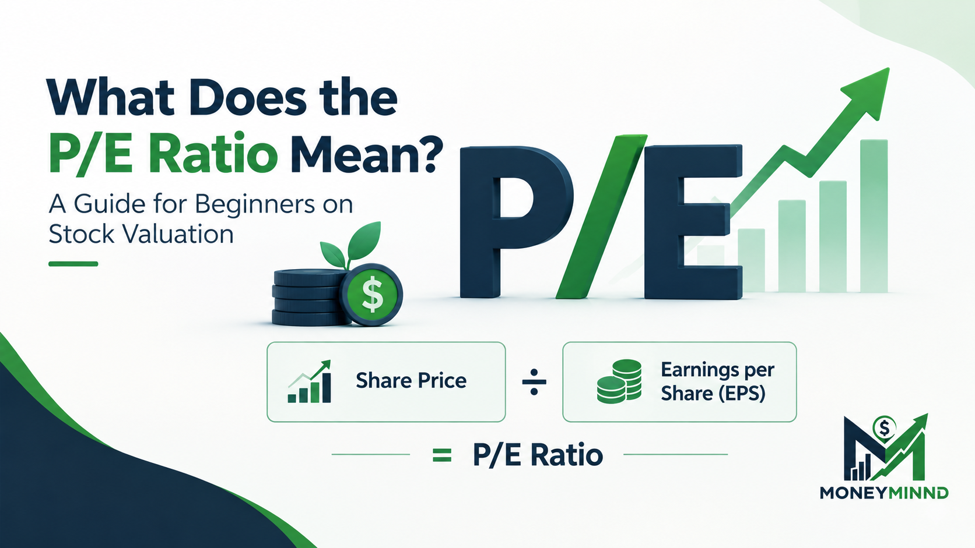
The PE ratio, which is generally known as the price-earnings ratio, compares a company’s share price with its earnings per share (EPS) and shows how much investors are ready to pay for each unit of the company’s earnings.
For instance, if a stock is trading at $100 per share and generates $5 per share each year, its valuation ratio will be 20. To put it simply, investors are paying $20 for each $1 of annual earnings per share.
This could be the result of a number of factors such as expected business growth, profitability, industry conditions, competitive advantages, and investor confidence; yet it does not give you all the data needed to assess a company’s financial health.
Just because a figure is high doesn’t mean that the stock is expensive, and a low figure doesn’t necessarily indicate that it’s a good bargain. Before coming to any conclusion, investors should take into account the company’s earnings quality, its growth prospects, its debt, and the state of the industry.
How Is the Price-to-Earnings Ratio Calculated?
The calculation is simple. To do it you have to have two things: the current market price per share and the company’s earnings per share.
Formula:
P/E Ratio = Price per Share divided by Earnings per Share
Earnings per share (EPS) represents the portion of a company’s profit attributable to each outstanding common share. It is generally calculated by dividing the net income available to common shareholders by the weighted average number of common shares outstanding.
A Simple Calculation
Suppose a company has the following financial data:
- Current share price: $120
- Annual earnings per share: $6
Using the formula:
PE ratio = $120 ÷ $6 = 20
The figure comes to 20, which shows that investors are paying $20 for each $1 of annual earnings per share.
The calculation serves as a basis for valuing the stock; in order to determine if the stock is reasonably priced you have to compare the figure with that of similar businesses, with the company’s past valuation, and with its future earnings potential.
A Detailed Example: Comparing Two Companies
Suppose that you are carrying out research on two companies which are in the same industry. They offer similar products and have business models that are comparable, but their share prices are different when compared to their earnings.
| Financial information | Company A | Company B |
| Share price | $100 | $150 |
| Annual EPS | $10 | $10 |
| PE ratio | 10 | 15 |
The ratio for Company A is obtained by dividing $100 by $10, which gives 10, and the ratio for Company B is found by dividing $150 by $10, resulting in 15.
Both companies have a profit of $10 per share, but investors are prepared to pay different prices for these earnings. Company A has a market price of 10 times its annual earnings per share, whereas Company B has a market price of 15 times its annual earnings per share.
Company A seems the more affordable at first sight, but a lower valuation doesn’t mean that it is the better investment.
If Company A is in a mature market which has limited growth, declining sales, or increasing competition, then investors might give it a lower valuation since they anticipate its earnings will stay the same or decrease.
On the other hand, Company B could have a stronger brand, which might lead to higher sales, better profit margins, or give it the chance to enter new markets. Since investors expect its earnings to increase, they may be prepared to pay a higher multiple.
There’s another possibility—that is, that Company A’s earnings might be boosted temporarily by a one-off gain, whereas Company B shows more steady profits. In such a case, the first comparison could be misleading.
What Conclusion Should an Investor Draw?
These figures show that Company A has a lower price-to-earnings ratio than Company B. However, this alone does not mean that Company A is undervalued or that Company B is overvalued. An investor who is careful would look at both companies’ financial statements, their growth expectations, their debt levels, their competitive positions, and the risks involved before making up his mind about whether either share is worth purchasing.
It shows why valuation ought to be regarded as a research tool rather than being used as a separate investment decision.
What Is the PE Ratio Used for in the Assessment of Shares?
It is useful to understand what the PE ratio is since it provides investors with a standard figure when comparing share prices to company earnings and can assist with various aspects of the investment research process.
1. Comparing Companies
By comparing companies that are in the same industry, investors can find out how the market values their earnings. For instance, two well-established companies which produce consumer goods may have different multiples due to differences in their growth, profitability, or risk.
Evaluations are more accurate when comparing companies that operate under similar business models and follow comparable accounting practices.
2. The Assessment of Market Expectations
A high valuation could be a sign that investors anticipate strong future earnings growth, while a lower valuation might show modest growth expectations, uncertainty, or concerns regarding the company’s future.
These are potential explanations rather than guaranteed outcomes, as stock prices can also be influenced by investor sentiment, interest rate changes, and short-term fluctuations in demand.
3. The Assessment of Historical Values
An investor can compare the company’s present multiple with its past historical levels. In that case, if the valuation is above normal the market might be expecting better future performance; but if it is below normal then investors might be worried about the company or potentially miss out on an opportunity.
When making historical comparisons it is necessary to take into account the changes that have occurred in the company’s business model, its profitability, its level of risk, and the wider economic conditions.
What Does a High or Low Price-Earnings Ratio Mean?
The valuation multiple will vary depending on the type of business and its particular situation, and there is no one figure which makes all shares cheap or expensive.
High PE Ratio
A high valuation ratio may be a sign that investors anticipate earnings will increase considerably in the future, and it is usual for certain rapidly growing businesses to have higher valuations than those which are mature.
A higher ratio may also suggest that the stock price has risen faster than the company’s earnings. The share price could fall even if the business is still making a profit, should the company fail to meet market expectations.
Low PE Ratio
A low price-earnings ratio may show that a stock is relatively cheap in comparison with its present earnings, and it can draw in investors who are looking for businesses that are undervalued.
In contrast, a low valuation could be due to falling profits, a high level of debt, weak competitive advantages, regulatory difficulties, or an uncertain future for the business. Investors ought to examine these risks before viewing a low multiple as an opportunity.
Types of PE Ratio
The two methods usually employed for working out this valuation measure are as follows.
Trailing PE Ratio
The trailing ratio is based on the earnings reported during the last 12 months; since it makes use of past results, it can give an indication of how the market values the company’s recently reported profitability.
The main limitation is that previous earnings do not necessarily indicate future performance, especially in the case of a company which is going through rapid growth, a decline, or experiencing unusual one-off events.
Forward PE Ratio
The forward ratio is based on estimated earnings for a future period, typically the following 12 months, and may assist investors in assessing the current market price of a company’s shares in relation to their expected profitability.
Forward estimates are not assured results; it is possible for analysts to alter their forecasts if business conditions change, and actual earnings may differ considerably from expectations.
Investors can get a balanced view by looking at both measures together with the financial results and the assumptions used in the earnings forecasts.
Limitations of the PE Ratio
Even though it is commonly used, this measure has some important limitations.
The ratio is not very useful when earnings are negative. In such a case, if a company records a loss, the conventional ratio cannot generally be interpreted in the same way as in the instance of a positive earnings multiple.
It does not necessarily show debt. Two companies which have the same earnings multiples may in fact have very different levels of borrowing and different financial risks.
The reported earnings can be influenced by the accounting methods employed and by unusual events. For example, one-off gains, restructuring expenses, and other non-recurring items have the effect of distorting earnings.
It depends on the industry. Companies in the banking sector, in the technology sector, among manufacturers, and in the utility sector operate in different business environments. Their usual valuations may thus be different.
It does not ensure that your investment will generate a profit. A share priced at a low multiple may still go down, and a stock which is currently highly valued might increase if its earnings turn out to be higher than expected.
It is for these reasons that investors ought to combine their valuation analysis with other factors, for example revenue growth, profit margins, return on equity, cash flow, debt levels, and business quality.
How Beginners Can Use the PE Ratio Wisely
New investors can use the following steps when researching a stock:
- Look at the most recent earnings, examine the company’s financial reports, and determine if the profits stated are recurring or have been influenced by one-off items.
- Look at companies that are similar. Instead of depending just on the general market averages, focus on firms that have the same business models as each other.
- Look at the company’s earnings growth and consider if its recent performance and future prospects warrant the valuation it currently has.
- Look at the debt and the cash flow; a company may show accounting profits even if it is experiencing financial difficulty due to borrowing or poor cash generation.
- Take the risks into account. You should look at the level of competition, the regulatory environment, the state of the economy, and any other factors that might impact future profitability.
- Do not make decisions on the basis of a single figure. Valuation should be considered one part of a broader investment strategy that aligns with your financial goals, investment timeline, and willingness to take risks.
Moneyminnd advises readers to be patient when carrying out financial research and to tell the difference between a valuation that looks attractive and one that is based on solid grounds.
Conclusion
The PE ratio is a good place to begin when trying to understand how the stock market values a company’s earnings, since you can obtain an idea of how much investors are paying for each unit of either reported or expected profit by dividing the share price by the earnings per share.
The P/E ratio becomes more useful when assessed alongside earnings growth, industry trends, debt levels, cash flow, and business risks. A low ratio does not necessarily mean a stock is undervalued, just as a high ratio does not automatically indicate that it is overpriced.
For anyone who is asking what the PE ratio is, the key point is that this ratio serves more use in helping to formulate better questions than in giving a ready-made answer; it should be used when comparing companies, for looking into market expectations, and as a way of directing further research.
We at Moneyminnd think that a good understanding of fundamental financial concepts is an important first step when it comes to making more informed investment decisions. Find out what the numbers mean, look into the business that gives rise to them, and keep in mind that all investments involve risk.