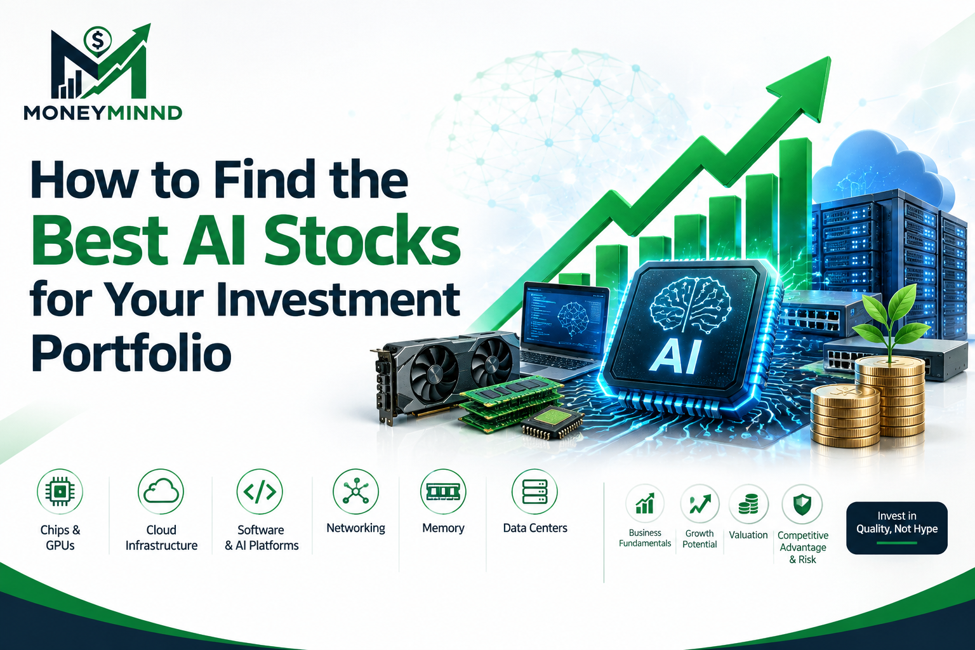
How to Find the Best AI Stocks for Your Investment Portfolio 2026
Artificial intelligence has evolved from a theoretical concept into a powerful force shaping industries such as technology, healthcare, finance, manufacturing, transportation, cybersecurity, and many more. As companies spend more on AI systems and tools, investors look at AI stocks to be part of this long-term tech change.
Selecting a company is not as simple as buying the stock that gets the online attention. Some AI stocks create processors, others provide cloud systems, while others use AI in their existing products. Their chances for growth, prices, advantages, and dangers can be very different.
For investors who look at the best AI stocks the main thing is to go beyond headlines and see how a company really makes money from AI. At Moneyminnd, we focus on basics: quality of business, price, position in the market, and dangers before we look at any investment.
What Are AI Stocks?
AI stocks are shares of companies that develop, provide, support, or benefit significantly from artificial intelligence technologies.
The group is bigger than chip makers. It can include:
- Chip and GPU makers
- Cloud computing companies
- Data-center companies
- Software companies that use AI in their products
- Cybersecurity companies that use machine learning
- Networking and memory chip suppliers
- Companies that create AI models and platforms
- Businesses that use AI to increase work and customer service
This difference matters because investors are not buying an AI model. By investing in these companies, investors are essentially taking a stake in businesses that could see their earnings and growth potential increase as the adoption of AI expands.
Why Are AI Stocks Attracting Investors?
The quick growth of AI systems has created opportunities across the tech world. For example, NVIDIA earned $96.2 billion in revenue for its quarter of 2027, with Data Center revenue hitting $89.0 billion, up 117 percent from the last year. The larger AI world is also growing beyond GPUs. Memory, networking, custom chips, cloud systems, software, and data-center building all have roles. Recent changes in the industry show this growth. Marvell Technology increased its 2028 revenue forecast to $20 billion because of demand for custom data-center chips, while companies like Micron have benefited from rising demand for high-bandwidth memory used in AI systems. This allows investors to gain exposure to a broader range of opportunities within the growing AI industry.
How to Choose the Best AI Stocks
1. Understand the Company’s AI Exposure
The first question should be simple: How does the AI stock actually make money? A business might make money by selling AI processors, providing computing, offering AI software, supplying memory, or adding AI features to existing products. Investors should separate AI stocks that bring real AI money from those that only use AI as a trend. Read company reports, earnings reports, investor talks, and management meetings to see where AI fits into the business.
2. Check Revenue and Profit Growth
Strong revenue growth can look good. Revenue alone does not tell the story.
Look at:
- Revenue growth
- Operating income
- Net income
- Free cash flow
- Gross margins
- Earnings per share
- Debt levels
- Capital spending
A company that grows fast but uses a lot of cash may have more risk than a long-standing business that makes good free cash flow. NVIDIA shows why financial data matters. Its 2026 revenue hit $215.9 billion up 65 percent from the year while Data Center revenue rose 68 percent to $193.7 billion. These numbers do not automatically make the stock a deal at every price. They show the importance of linking an AI story to business numbers.
3. Look for a Lasting Advantage
AI changes fast. Competitors can change quickly. Before buying an AI stock think about whether it has an advantage like:
- Tech
- Patents
- Large systems
- Developer communities
- Valuable customers
- Distribution leads
- Brand
- Size
- High costs to switch
A company that has spent billions on systems and built a big community may stand out differently from a business trying to enter the market.
4. Check the Price
A common mistake investors make is assuming that a strong company is automatically a good investment, regardless of the price they pay for its shares. A stock may show an AI part yet still cost a lot compared to the money it could earn in the future.
Useful price tools can include:
- Price-to-earnings (P/E): This compares a company’s share price to its earnings.
- Price-to-sales (P/S): This is especially useful when a growing company does not yet have earnings.
- Price-to-free-cash-flow: This helps investors see how much they are paying for a company’s cash generation.
- PEG ratio: The PEG ratio compares a company’s price to its expected earnings growth. Forecasts can be uncertain.
These tools should be compared with levels, competitors, growth expectations, and the overall quality of the company’s money.
5. Look at Management and Money Use
Management choices can greatly affect returns for stock owners. Investors should check whether management is using money to invest in good projects, controlling expenses, managing acquisitions well, and sharing realistic plans. AI needs lots of money in areas like data centers, chips, research, networking, and energy systems. That is why money use is especially important for companies in the AI world.
6. Think About Customer Focus
A company may look very successful while depending heavily on one customer. This can add risk. For example, chip and systems companies may rely on cloud providers or tech firms for much of their demand. If a major customer reduces spending, switches to another supplier, or develops its own technology, the company could experience slower growth and weaker future performance. Investors should therefore check customer focus. How stable long-term demand is.
AI Stocks Worth Looking Into
There is no one-size-fits-all list of AI companies to invest in because the right choice depends on factors such as valuation, risk tolerance, investment horizon, and financial goals. However, several major companies may be worth considering when building an AI-focused watchlist.
NVIDIA (NASDAQ: NVDA)
NVIDIA is one of the companies in the AI narrative. Its fast computing platforms, GPUs, networking products, and software systems are widely used for AI work.
Possible strengths: AI narrative leadership, software systems, demand.
Key dangers: Investors should also consider factors such as market expectations, valuation, competitive pressure, semiconductor cycles, export restrictions, and the company’s dependence on sustained investment in AI.
Microsoft (NASDAQ: MSFT)
Microsoft offers another way to get AI exposure because AI is built into its cloud, work, developer, and business systems.
Possible strengths: Azure, corporate partnerships, software infrastructure, and revenue streams.
Key dangers: Heavy AI systems costs, competition, legal issues, and the challenge of turning AI investment into long-term profits.
Alphabet (NASDAQ: GOOGL)
Alphabet is another company for investors looking at intelligence. Google has integrated AI capabilities across Search, Cloud, Workspace, and several other products. Its Gemini models are embedded throughout its ecosystem, while Google Cloud provides businesses with AI models, infrastructure, and tools to develop and deploy AI solutions.
Possible strengths: AI research expertise, Google Cloud capabilities, global reach, extensive data resources, and a strong software ecosystem.
Key dangers: Competition in AI search and cloud computing, high systems costs, legal pressure, and possible changes in search economics.
Broadcom (NASDAQ: AVGO)
Broadcom provides exposure to another important part of the AI growth story through its networking technologies and custom chip solutions. The growth of custom AI accelerators allows big tech companies to go beyond general-purpose GPUs. Recent market changes show demand for custom chips, which helps companies like Broadcom and Marvell.
Possible strengths: Networking, custom chips, tech business.
Key dangers: Chip cycles, customer focus, competition, integration risks, and price.
Micron Technology (NASDAQ: MU)
AI systems require substantial amounts of high-speed, high-performance memory to process and handle complex workloads efficiently. Micron is another company investors might look at for the AI systems chance. Recent results showed demand for memory. The company reported long-term customer agreements. Expects memory supply and demand.
Possible strengths: AI memory demand, memory coverage, chip position.
Key dangers: Memory markets can be cyclical and volatile, with supply and demand shifting over time while production and operating costs remain high and prices may drop.
Don’t Miss AI Stock Dangers
The AI chance is big. You should not think that quick tech use will always lead to money gains.
High prices: The market may value shares before the company makes money.
Competition: AI withdraws money from tech companies and new startups.
Rules: Governments may introduce regulations covering data usage, AI models, copyright, privacy, and competition, which could affect how companies develop and deploy AI technologies.
Systems limits: AI growth needs chips, power, data centers, network parts, and special elements. Limited power and systems can slow growth.
Change: The best tech today may be replaced by a system later.
Concentration danger: Owning companies in the AI group does not really spread risk.
How to Build an AI-Focused Portfolio
By picking stocks only because they are connected to AI, you can build a mix. For example, a portfolio could mix tech companies, chip makers, systems companies, and companies that use AI software. Look at what you own. If you already have tech stocks, adding similar AI firms may make your portfolio riskier instead of safer. The amount you invest in each stock matters. Even a fundamentally strong company can experience periods of significant share-price declines.
A careful investor should have a plan before buying:
- Why am I buying this company?
- What could cause my plan to fail?
- What price am I ready to pay?
Conclusion
Finding AI stocks requires more than reading the AI headline. Investors should understand a company’s business model, evaluate its financial performance, identify its competitive advantages, assess its valuation, and recognize potential risks that could limit the growth of AI. Companies such as NVIDIA, Microsoft, Alphabet, Broadcom, and Micron let you join the growing AI world. Evaluate each company individually rather than applying the same criteria or assumptions to every business.
For Moneyminnd readers, the main lesson is simple: invest in companies, not hype. Artificial intelligence may be one of the tech changes of our time, but good investing still relies on price, money, health, spreading risk, patience, and careful risk control. Before investing, review the company’s financial reports, current valuation, business plans, and how the investment aligns with your personal financial goals. Past results and being an AI company do not guarantee gains.