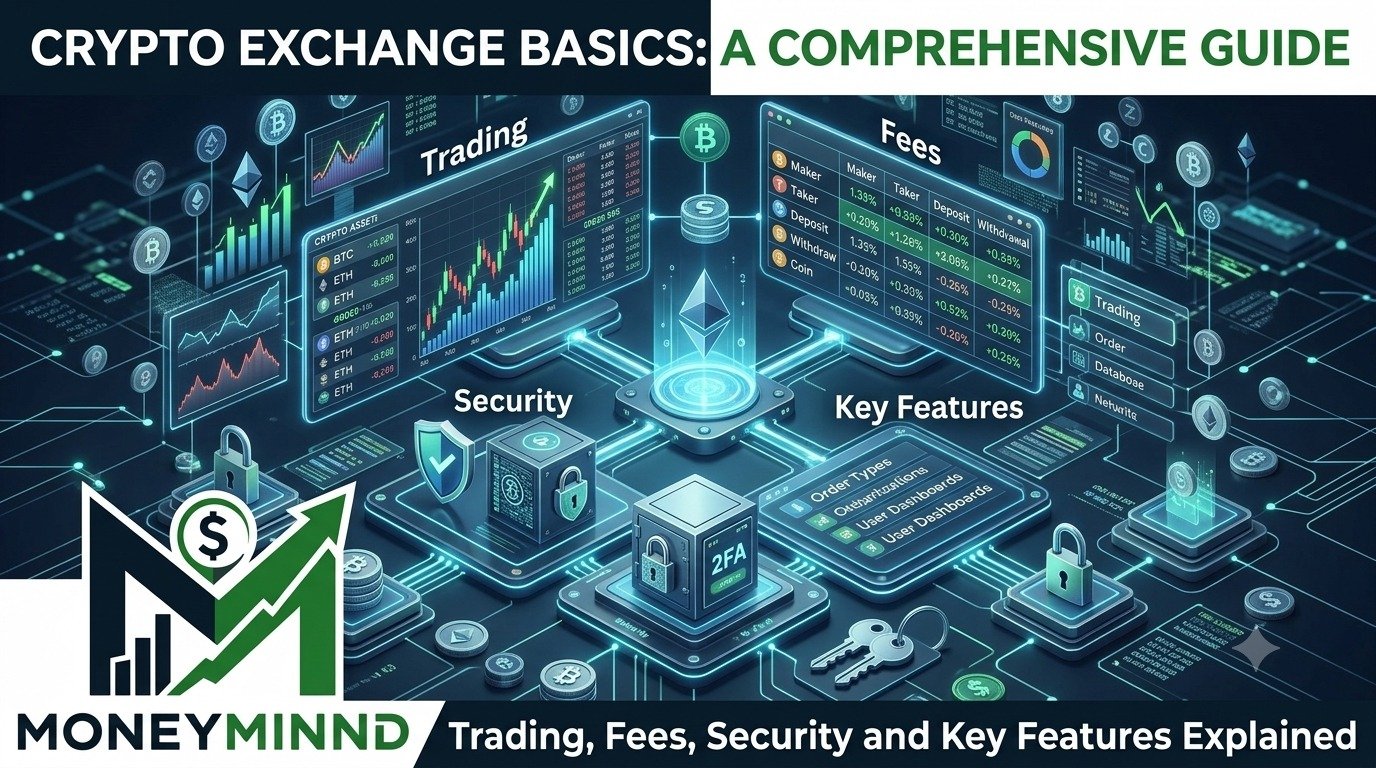
Crypto Exchange Basics: Trading, Fees, Security and Key Features Explained
The cryptocurrency market has changed how people think about buying, selling, and transferring assets. Unlike financial markets, crypto markets run on special online platforms that let users trade assets such as Bitcoin, Ethereum, stablecoins, and many other digital tokens. For someone who’s new to this market, understanding how a Crypto Exchange works is one of the most important steps to make informed decisions.
A Cryptocurrency Exchange essentially provides a marketplace where users can buy and sell assets. However, exchanges are not the same. They can differ a lot in the cryptocurrencies they offer, the trading tools they provide, the fees they charge, the security practices they follow, the withdrawal policies they have, the liquidity they provide, and the regulatory status they maintain.
This guide from Moneyminnd explains the fundamentals in simple language. Whether you are new to the world of cryptocurrency. Already have some experience understanding how exchanges operate can help you evaluate platforms more carefully and see the costs and risks involved.
Important: Cryptocurrency markets can be very volatile and speculative. An exchange can give you access to a market. It does not remove investment risk. Regulations and consumer protections also differ by jurisdiction and by platform.
What Is a Crypto Exchange?
A Crypto Exchange is a platform that helps you buy, sell, and sometimes swap cryptocurrencies. Depending on the platform and jurisdiction, users can exchange cryptocurrency for government‑issued currency, such as U.S. Dollars or euros, or trade one asset for another.
For example, someone might deposit currency and use it to buy Bitcoin. Another trader might exchange Bitcoin for Ethereum. Advanced users can access trading pairs, limit orders, derivatives, staking services, or other products where allowed.
At a high level, a Crypto Exchange connects buyers and sellers and gives an infrastructure to execute transactions.
It is important, however, not to assume that every platform called an “exchange” works under the regulatory framework as a traditional securities exchange. Investor.gov notes that crypto platforms can perform combinations of exchange, brokerage, and custody functions, while the protections that apply to regulated markets may not work in the same way.
This difference makes research especially important before you deposit money or digital assets.
How Does a Cryptocurrency Exchange Work?
The basic process is quite simple.
First, a user creates an account. Completes any identity‑verification procedures required by the platform. Depending on the jurisdiction and provider, this may involve submitting identification information.
Next, the user deposits funds. The available methods can include bank transfers, cards, or transfers of cryptocurrency from another wallet, although the options vary.
Once funds are available, the user can select a cryptocurrency. Place an order. The platform then tries to match the order with another participant or otherwise execute the transaction according to its trading system.
After buying cryptocurrency, the asset may stay under the Crypto Exchange’s custody. Be moved to an external wallet.
This final point is especially important. When assets stay on a Crypto Exchange, the platform may control the keys that belong to those assets. Under third‑party custody, the service provider manages access to the keys. Investor.gov advises investors to investigate how a custodian stores assets, protects keys, handles customer assets, and responds if the provider fails.
Centralized vs. Decentralized Exchanges
Not every crypto marketplace works in the same way.
- Centralized Exchanges
An exchange, commonly abbreviated as CEX, is run by a company or organization.
Users typically create accounts, deposit funds, and interact with a trading interface. The platform generally manages order matching. May provide custody services.
Common features can include:
● Account‑based trading
● Identity verification
● Fiat deposits and withdrawals
● Order books
● Trading charts
● Customer support
● Crypto custody
● Trading APIs
● Advanced order types
The convenience of platforms can make them easy for beginners. However, users also need to think about the risks that come from relying on a party.
If a Crypto Exchange experiences a security incident, operational problem, insolvency event, or regulatory restriction, customers could potentially have trouble accessing their assets.
- Decentralized Exchanges
Decentralized exchanges or DEXs usually use blockchain‑based contracts to facilitate transactions without relying on a centralized intermediary.
Instead of creating a conventional account and putting assets into an exchange‑controlled balance, users may connect compatible wallets and interact directly with smart contracts.
I think DEXs can give you advantages and different risks compared with centralized platforms. Users may have control over their assets, but they also must manage their wallets, confirm transactions, and keep their private keys safe.
A mistake with a wallet address or a transaction can be irreversible.
For beginners, understanding the difference between custody and self‑custody is essential.
What Can You Trade on a Crypto Exchange?
The assets available vary a lot from one platform to another.
Major categories may include:
– Bitcoin
– Ethereum
– Stablecoins
– Altcoins
– Tokens
The availability of an asset should never be taken as an endorsement of its quality or safety. Investors should research the asset on their own.
Understanding Crypto Trading Pairs
A trading pair tells you which asset is being exchanged for another.
For example:
BTC/USD means Bitcoin is being traded against U.S. Dollars.
Similarly:
ETH/BTC represents Ethereum priced in Bitcoin.
If Bitcoin is quoted at $100,000 in a BTC/USD market, that means one Bitcoin costs $100,000 at that moment. The actual price a trader sees can vary based on market conditions, liquidity, order type, and other factors.
I think understanding trading pairs is important because a cryptocurrency may have trading activity against one asset but much lower activity against another.
Market Orders vs. Limit Orders
One of the trading concepts beginners meet is the difference between market and limit orders.
- Market Order
I think a market order is designed to execute at the best available prices in the market.
Its advantage is speed.
Its disadvantage is that the final execution price can differ from the price you saw when you submitted the order in a quickly moving or less‑liquid market.
- Limit Order
A limit order lets a trader specify the price they want to pay when buying or the minimum price they want to receive when selling.
For example, suppose Bitcoin trades around $100,000, and you want to buy only if the price falls to $98,000. You can place a limit order at that level.
However, a limit order does not guarantee execution. The market must reach the price, and there must be enough liquidity.
For traders, understanding the difference between execution certainty and price certainty is valuable.
Crypto Exchange Fees Explained
Fees are one of the overlooked aspects when choosing an exchange.
A platform may advertise trading fees while charging other costs for deposits, withdrawals, conversions, or extra services.
Common charges can include:
– Trading Fees
– Deposit Fees
– Withdrawal Fees
– Conversion Fees
– Network Fees
The important lesson is to look at the cost, not just one advertised fee.
Investor.gov similarly advises investors to understand transaction and transfer fees and other account‑level costs before choosing a provider.
Why Fees Matter to Long-Term Investors
Small fees can add up when many trades happen or when a portfolio is big.
Think of a trader who buys and sells multiple times in a year. Even if each trade has a small fee, the total of all fees can lower the final profit.
Fees may include:
● Trading commissions
● Spreads
● Withdrawal charges
● Conversion costs
● Network fees
● Account‑related charges
That’s why looking only at the listed trading fee can give a false picture.
Before you start using an exchange, read the fee schedule and learn how the platform figures the charge.
What Is the Safest Crypto Exchange?
No single answer tells you which platform is safest for every person. Safety depends on things such as the platform’s security controls, how it holds assets, its regulatory status, its track record, how open it is, how it protects accounts, and how the user protects themselves.
Do not pick a platform just because it says it is secure. Look for evidence.
Consider asking:
● Does the platform use multi‑factor authentication?
● Does it offer withdrawal protections?
● How are customer assets stored?
● Does it use storage?
● What information does it disclose about custody?
● Does it publish security policies?
● What regulatory requirements apply in the user’s jurisdiction?
● Does it clearly explain its fees?
● What happens if an account is compromised?
● Does it provide account alerts?
● How does it handle customer complaints?
Investor.gov specifically says to research third‑party custodians, ask how crypto assets and private keys are protected, learn about insurance, and find out what happens if the custodian fails.
Important Security Features to Look For
You should think about security before you put money in, not after a problem happens.
- Multi‑Factor Authentication
Multi‑factor authentication adds another check that’s separate from a password.
Depending on the platform, users can use an authenticator app, a security key, a passkey or another type of check.
Investor.gov recommends using passwords or passphrases and using multi‑factor authentication when you can.
- Withdrawal Controls
Some platforms require checks for withdrawals or let users limit withdrawals to approved addresses.
These features can lessen the damage if an account is taken over.
- Login Alerts
Account notifications can help users spot activity fast.
Alerts can cover login attempts, password changes, transfers, or other account actions.
- Cold Storage
Cold storage generally means keeping crypto assets offline.
It can lower risk from some threats, but it does not remove all danger.
Cold wallets can be lost, broken, or stolen, and users must still protect the keys that open them.
- Security Keys and Passkeys
Some services allow hardware security keys or passkeys.
These can give protection against some key‑theft attacks.
Security technology keeps changing, so users should see which options a platform offers.
Exchange Custody vs. Self‑Custody
An important choice in crypto is deciding who holds the private keys.
When an exchange holds keys, the platform usually manages the keys that belong to customers.
When a user has self‑custody, the user holds the keys.
Both ways bring responsibilities.
Exchange custody can be convenient because the provider takes care of technology.. Users rely on the provider’s systems and rules.
Self‑custody gives control but moves the duty onto the individual.
If a wallet’s private key or seed phrase disappears, you may lose access to the assets.
Investor.gov stresses that private keys and seed phrases must never be shared and must be stored safely.
Liquidity: Why It Matters
Liquidity means how easily an asset can be bought or sold without changing its price a lot.
An exchange that has liquidity usually has more buyers and sellers. This can make it easier to place orders close to the shown market price. Markets with liquidity can act differently. A big order can shift the price a lot. Have more slippage.
Because of this, traders should look past how many coins are listed and check the trading activity for the assets and pairs they want to trade.
Understanding the Spread
The spread is the difference between the price buyers want to pay and the lowest price sellers want to accept.
For example, picture the buying price at $99,950 and the best selling price at $100,050. The difference between those prices is the spread. A narrow spread usually shows that buyers and sellers are closely aligned, whereas a wider spread can raise the true cost of making a trade.
This is another reason why the advertised commission does not always cover the trading cost.
Key Features to Compare Before Choosing an Exchange
When comparing a cryptocurrency exchange, examine the platform instead of only one feature.
1. Supported Assets
Make sure the exchange supports the cryptocurrencies you actually plan to use. Having listings does not automatically make the exchange better for you.
2. Trading Interface
Beginners may like an interface, while experienced traders may want advanced charts, order books, indicators, and many order types.
3. Fees
Review trading fees, withdrawal fees, deposit fees, conversion fees, and network-related charges.
4. Liquidity
Look at trading activity for the pairs you plan to trade.
5. Security
Review authentication methods, custody practices, withdrawal controls, account alerts, and other security features.
6. Payment Methods
Check whether the exchange supports the deposit and withdrawal methods that’re available in your country.
7. Customer Support
Reliable support can become especially important if an account is locked or a transaction needs investigation.
8. Regulatory and Legal Information
Determine which entity runs the platform, where it is based, what licenses or registrations apply, and which rules govern its services in your jurisdiction.
9. Withdrawal Options
An exchange may allow trading. Have different restrictions or costs for moving assets elsewhere.
10. Transparency
Clear explanations of fees, custody, risks, terms, and policies can help users understand what they are agreeing to.
How to Find a Crypto Exchange That Fits Your Needs
Searching for the cryptocurrency exchange can be tempting, but no single platform is necessarily suitable for every user.
Instead, define what you need first.
A beginner might prioritize:
● navigation
● Educational resources
● Straightforward purchases
● Clear fees
● Strong account security
● Accessible customer support
An experienced trader might prioritize:
● Advanced order types
● High liquidity
● Detailed charts
● API access
● Competitive trading costs
● Multiple trading pairs
Someone focused on long-term holding may care more about custody, withdrawal controls, asset support, and security practices.
This approach is more useful than picking an exchange from a generic ranking.
Red Flags to Watch For
Crypto users should be especially cautious of platforms or individuals promising guaranteed returns.
A legitimate trading platform cannot remove the underlying volatility of cryptocurrency markets.
Investor.gov and the CFTC have warned about digital-asset websites that promise unusually high or guaranteed returns with little or no risk.
Other warning signs include:
● Guaranteed profits
● Pressure to deposit
● Unsolicited investment offers
● Requests for private keys
● Requests for seed phrases
● Fake customer‑support accounts
● Unverified websites
● Pressure to send crypto to a personal wallet
● Promises of exclusive investment opportunities
● Difficulty withdrawing funds
● Vague information about the company operating the platform
A professional-looking website does not automatically prove legitimacy.
Phishing and Fake Exchange Websites
One major risk is accidentally using a website that imitates a legitimate platform.
- Scammers can create websites, advertisements, emails, social‑media profiles, and customer‑support accounts designed to look genuine.
- Always check the website URL carefully before entering your login details. Avoid clicking links received through unsolicited messages.
- Use. Manually navigate to the official platform when possible.
Investor.gov has specifically warned that fraudsters can use advertisements and imitation websites to steal account credentials, including authentication codes.
Protecting Your Exchange Account
- Security practices should become part of your routine.
- Use a password or passphrase.
- Enable multi‑factor authentication.
- Consider authentication options such as security keys or passkeys when available.
- Turn on account notifications.
- Review. Withdrawals regularly.
- Never share your password, authentication codes, private keys, or seed phrase.
- Do not store recovery information in an easily accessible online location.
- Be suspicious of anyone claiming to represent an exchange who asks you to transfer cryptocurrency to “secure” your account.
- Your exchange’s legitimate support team should not need your key or seed phrase.
Cryptocurrency Exchange Regulations
Regulation is one of the complicated parts of the crypto market because rules change a lot from one country to another and from one type of service to another. A crypto exchange that works in one jurisdiction may have to satisfy licensing, registration, reporting, consumer‑protection, or anti‑money‑laundering rules that are different from those of a similar crypto exchange that works in another jurisdiction.
Therefore, you should check the entity that offers the service and the regulatory rules that apply in your own location. Do not assume that the word “exchange” means the crypto exchange has the regulatory status or investor protections as a traditional stock exchange.
Investor.gov notes that some crypto trading platforms may combine functions that would normally be performed by regulated entities, and the protections can be different.
Are Crypto Exchange Assets Insured?
It is important to verify the details instead of relying on assumptions. Traditional bank deposits and some securities accounts may have insurance or investor‑protection plans under the laws that apply. Crypto assets can be treated differently.
Whether crypto exchange assets are insured depends on what they are. Under what circumstances depends on the provider, jurisdiction, asset type, and the legal rules that apply. Before you put a lot of money into a crypto exchange, carefully read the platform’s insurance or protection information.
Investor.gov advises you to ask custodians if they provide insurance against loss or theft and to understand the terms. Never assume that all crypto on a crypto exchange automatically gets the protections as money in a bank account.
Crypto Exchange vs. Crypto Wallet
A crypto exchange and a crypto wallet have different purposes. A crypto exchange is mainly a marketplace or service that lets users buy, sell, or trade assets. A crypto wallet is a tool that manages the keys that are needed to authorize transactions.
Importantly, a crypto wallet does not literally hold cryptocurrency like a physical wallet holds cash. It manages the keys that give access to assets that are recorded on a blockchain. A user can buy cryptocurrency on a crypto exchange. Then move it to a personal crypto wallet. Understanding this difference can help beginners make choices about custody and security.
Common Mistakes Beginners Make
- Choosing an Exchange Based on Low Fees
Low fees can be attractive, but fees are only one part of the equation.
Security, liquidity, asset availability, withdrawal policies, and regulatory rules also matter.
- Ignoring Withdrawal Fees
A crypto exchange may have trading but charge large fees when assets are moved elsewhere.
Always check withdrawal costs.
- Leaving Everything on an Exchange
Keeping crypto on a crypto exchange may be convenient. It means you rely on the platform for custody.
You should understand the risks. Make custody decisions based on your circumstances.
- Using the Same Password Everywhere
If one account is compromised, using the credentials can expose other accounts.
Use credentials for important financial services.
- Sharing a Seed Phrase
A seed phrase should be treated as sensitive information.
Anyone who gets it may control the associated crypto wallet.
- Chasing Guaranteed Returns
Promises of guaranteed crypto profits should be taken as a warning sign.
There is no shortcut that removes market risk.
- Trading Without Understanding Orders
Submitting a market order without knowing slippage or using leverage without knowing liquidation risk can produce unexpected results. Learn how the trading mechanism works before putting in money.
How to Choose an Exchange: A Practical Checklist
Before opening an account, consider the following checklist:
Platform
● Who operates the crypto exchange?
● Which country or jurisdictions does it serve?
● What legal entity will hold your account?
Assets
● Which cryptocurrencies are supported?
● Are the trading pairs you need available?
Fees
● What are the trading fees?
● Are there spreads?
● What are the deposit and withdrawal costs?
● Are there network charges?
Security
● Is multi‑factor authentication available?
● Are withdrawal protections offered?
● How are customer assets stored?
● Does the provider explain its custody arrangements?
Access
● Can you. Withdraw using methods available in your location?
● Are there transaction limits?
● Are there account restrictions?
Support
● Is customer support available through channels?
● Does the platform provide documentation?
Risk
● How does the platform respond to service outages or downtime?
● What protections are available if your account is compromised?
● What protections if any apply to customer assets?
This checklist can help turn a search for a crypto exchange into a structured comparison.
Why Transparency Matters
A strong crypto exchange should make important information understandable.
Users should not have to search through pages to discover basic information about fees, withdrawals, custody, or restrictions on a crypto exchange. Transparency does not guarantee that a crypto exchange is risk‑free. It gives users more information with which to evaluate the crypto exchange.
Moneyminnd encourages readers to look beyond claims and examine the underlying details of any crypto exchange before using the crypto exchange.
The Role of Research in Crypto Trading
Research should not stop after selecting a crypto exchange.
Users should also understand the cryptocurrency they are purchasing.
Consider:
● What problem does the project attempt to solve?
● Who developed it?
● How does its blockchain work?
● What is its supply structure?
● How liquid is the asset?
● What are its major risks?
● What regulations may affect it?
● What happens if the project fails?
Crypto markets can change quickly. A crypto exchange’s availability of an asset does not establish its long‑term value.
Investor.gov emphasizes the importance of conducting due diligence when evaluating investments and understanding risk, fees, liquidity, and fraud concerns for a crypto exchange.
Crypto Exchange Features for Advanced Users
Once users become more experienced, they may encounter tools for a crypto exchange.
- Advanced Order Types
These can include stop orders, stop‑limit orders, and other conditional trading instructions on a crypto exchange.
Each has its mechanics and risks for a crypto exchange.
- Trading Charts
Advanced interfaces on a crypto exchange can provide candlestick charts, volume data, technical indicators, and multiple timeframes.
These tools may help experienced traders analyze markets on a crypto exchange but do not guarantee trades.
- API Access
Application programming interfaces can allow users or developers to connect software to crypto exchange accounts.
APIs may support automated trading, portfolio tracking, or data analysis for a crypto exchange.
Because APIs can sometimes provide trading or withdrawal permissions, users should configure permissions carefully. Avoid granting unnecessary access to a crypto exchange.
- Derivatives
Some crypto exchanges provide futures, options, perpetual contracts, or other derivatives where permitted.
These products can involve greater complexity and risk than straightforward buying and selling on a crypto exchange.
Beginners should understand leverage, margin, liquidation, funding mechanisms, and counterparty risks before considering products on a crypto exchange.
Why Security and Fees Should Be Considered Together
Choosing a crypto exchange is not simply a question of finding the fee. Imagine two platforms.
Platform A has low trading costs but limited security controls and unclear custody information on a crypto exchange.
Platform B has higher fees but provides clearer disclosures, stronger authentication options, transparent withdrawal policies, and more detailed custody information on a crypto exchange.
The comparison cannot reasonably be reduced to the trading commission alone for a crypto exchange.
Financial decisions should consider the cost and risk profile of a crypto exchange.
Final Thoughts
Understanding the basics of a crypto exchange is a starting point for anyone interested in digital assets. A crypto exchange can provide access to cryptocurrency markets, but the crypto exchange you choose can affect your trading experience, transaction costs, custody arrangements, and security exposure. A crypto exchange should therefore be evaluated using more than its interface or promotional offers.
Look carefully at fees, liquidity, supported assets, withdrawal options, security controls, custody practices, regulatory information, and transparency for a crypto exchange. When searching for a crypto exchange, focus on the features that match your own requirements rather than relying solely on generic rankings for a crypto exchange. Similarly, when looking for a crypto exchange, examine specific security practices and custody information instead of accepting a marketing claim at face value for a crypto exchange.
Crypto markets remain volatile. Can involve substantial losses. The goal of learning how crypto exchanges work is not to eliminate risk but to understand the mechanisms, costs, and responsibilities involved before committing money to a crypto exchange. For accessible financial education and practical investing insights, Moneyminnd can help readers build a stronger foundation for understanding today’s changing financial landscape with a crypto exchange.
Frequently Asked Questions
Q – What is a Crypto Exchange?
Ans – A crypto exchange is a platform that facilitates buying, selling or exchanging cryptocurrencies. Depending on the crypto exchange, it may also provide custody, trading tools, payment services, and other features.
Q – How do Crypto Exchanges make money?
Ans – Exchanges can generate revenue through trading fees, spreads, withdrawal charges, listing services, subscriptions, custody services, or other products. The exact business model differs by provider for a crypto exchange.
Q – Are Cryptocurrency Exchanges safe?
Ans – Safety differs from one exchange to another.
Q – What are crypto exchange fees?
Ans – Crypto exchange fees can include trading fees, spreads, deposit fees, withdrawal fees, conversion costs, and blockchain network fees. The exact charges depend on the crypto exchange platform and the transaction.
Q – Should I keep cryptocurrency on a crypto exchange?
Ans – Keeping cryptocurrency on a crypto exchange can be convenient. It involves relying on a third party for custody. Self‑custody gives the user control over keys, but it also makes the user responsible for protecting them.
Q – What is the difference between an decentralized exchange?
Ans – A centralized crypto exchange is operated by a company or organization. Commonly provides account‑based trading and custody services. A decentralized crypto exchange generally uses blockchain‑based contracts and allows users to interact through compatible wallets.
Q – What makes a crypto exchange trustworthy?
Ans – Important factors for a crypto exchange include fees, clear custody information, strong security controls, appropriate regulatory information, reliable withdrawal processes, useful customer support, and a clear explanation of risks.
Q – What should I look for in the crypto exchange?
Ans – Rather than relying on a “safest”, label, examine specific safeguards such as multi‑factor authentication, withdrawal controls, asset‑custody practices, account alerts, security po,licies and applicable regulatory requirements.
Q – Can I lose money using a crypto exchange?
Ans – Yes. Losses can result from cryptocurrency price volatility, trading mistakes, fraud, security incidents, platform failures, or other risks. Crypto assets can be highly speculative. The user should only risk money that the user can afford to lose.
Q – Why are crypto exchange fees important?
Ans – Fees reduce the amount of money available for investment or trading. Comparing the cost including trading fees, spreads, withdrawals, and other charges—can provide a more realistic picture of what a crypto exchange costs.