S&P 500, Nasdaq & Nvidia: AI, Rate & Oil Risks in Focus
U.S. stocks are once again showing resilience after a volatile start to September, with technology shares helping major indexes recover from recent losses. Investors are balancing several competing forces at the moment: expectations for Federal Reserve policy, elevated oil prices, Treasury yields, corporate earnings, and the extraordinary influence of artificial intelligence on the technology sector.
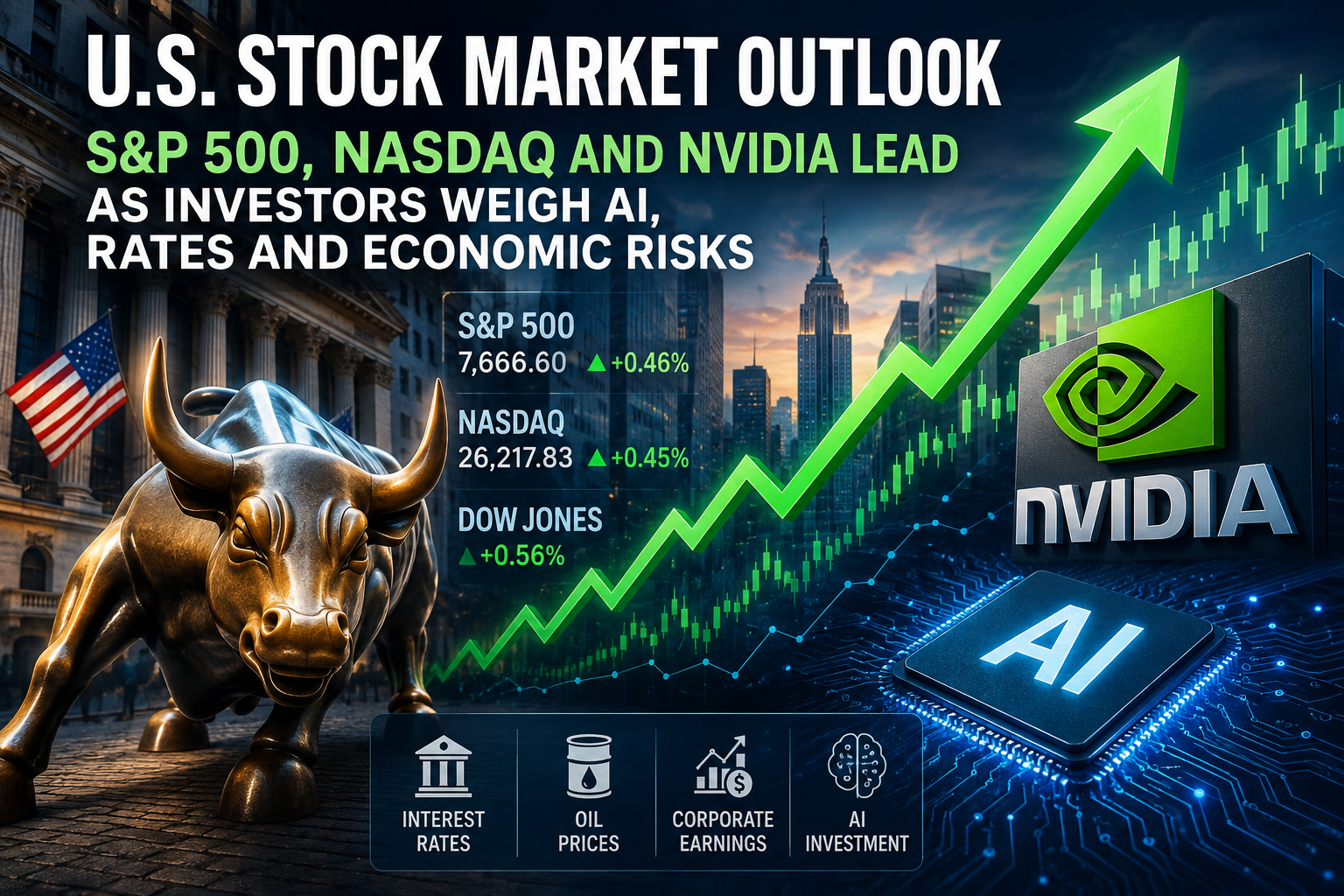
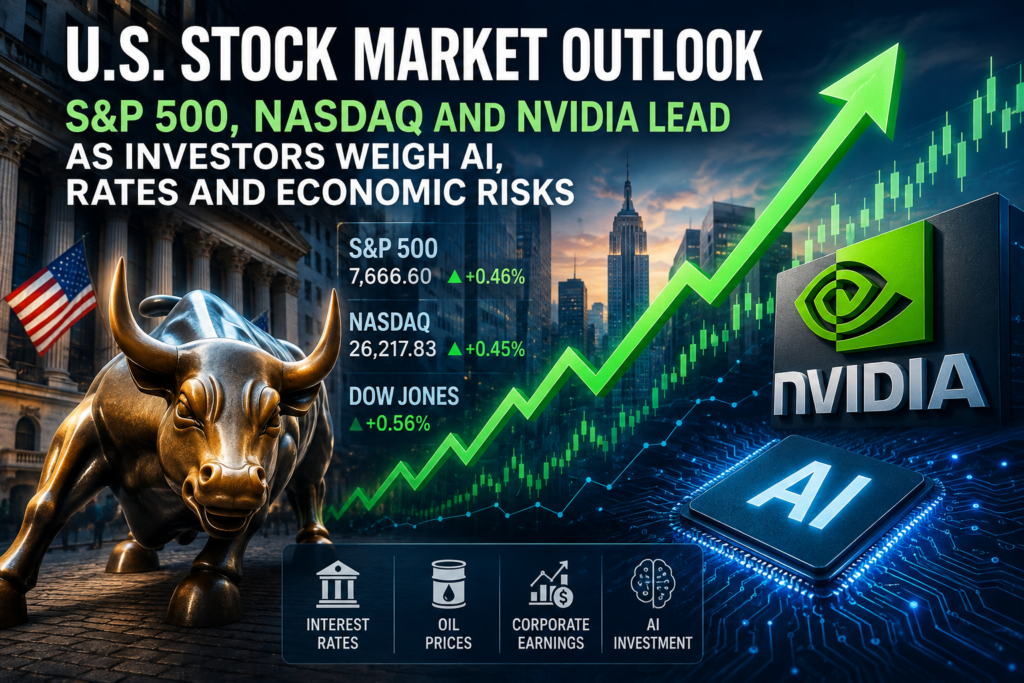
On Wednesday, September 2, the S&P 500 rose 0.46% to 7,666.60, while the Nasdaq Composite gained 0.45% to 26,217.83. The Dow Jones Industrial Average advanced 0.56%. Technology and semiconductor stocks were among the important contributors, with Nvidia gaining more than 3%.
The rebound continued into Thursday trading. The market opened higher, with the S&P 500 up about 0.6% and the Nasdaq up around 0.8%. Nvidia shares also gained. Investors were responding partly to comments from Federal Reserve Governor Christopher Waller, who indicated that he was inclined to keep rates steady if inflation continues to improve.
For investors, however, the bigger question is not whether stocks can rise on a particular day. It is whether the underlying earnings, economic growth and AI investment cycle are strong enough to justify elevated valuations. At Moneyminnd, we believe this is where investors should focus their attention.
What Is Driving the U.S. Stock Market Right Now?
The current market environment is being shaped by several interconnected factors rather than a single headline. Interest rates remain particularly important. Higher Treasury yields increase borrowing costs for companies and consumers and can make bonds relatively more attractive compared with stocks. They can also place pressure on growth companies whose valuations depend heavily on future earnings.
At the same time, corporate America continues to benefit from strong demand for technology, cloud computing, semiconductors and artificial intelligence. This creates an interesting market dynamic. Investors are simultaneously asking:
● Will inflation continue to moderate?
● Will the Federal Reserve eventually lower interest rates?
● Can corporate earnings continue growing?
● How much more can companies spend on AI infrastructure?
● Are technology valuations already pricing in too much optimism?
● Could higher oil prices reignite inflation?
● Will economic growth remain strong enough to support stocks?
These questions help explain why market movements have remained sensitive to economic data and comments from policymakers. The 10-year Treasury yield was around 4.78% at Wednesday’s close, while oil prices remained elevated amid geopolitical tensions. In other words, investors are navigating a market where strong corporate growth exists alongside meaningful macroeconomic risks.
S&P 500 Remains a Key Barometer for U.S. Equities
The S&P 500 is one of the most closely followed measures of the U.S. stock market because it represents 500 leading large-cap companies and covers approximately 80% of available U.S. market capitalization. That makes the index useful for understanding the broader direction of American equities.
According to S&P Dow Jones Indices, the index finished August with a 12.28% price return for the year through August 31, while its one-year price return was 18.98%. Those numbers illustrate an important point: despite occasional corrections and periods of uncertainty, large-cap U.S. stocks have maintained considerable momentum.
But investors should not interpret index gains as evidence that every company within the index is performing equally well. The index is weighted according to market capitalization. Consequently, the largest companies can have a substantial influence on its performance. This is particularly important during an AI-driven market cycle.
Large technology companies have become enormous businesses, and movements in their share prices can influence the direction of the entire index. This means the headline performance of the S&P 500 can sometimes mask differences between large technology companies and smaller or less technology-focused businesses.
Interestingly, the S&P 500 also performed well even without the Magnificent Seven stocks. S&P Dow Jones Indices reported a 14.19% year-to-date price return for that index through August 31. That suggests the current market story is broader than simply a handful of technology stocks.
Nasdaq Continues to Reflect the AI Investment Cycle
The Nasdaq Composite is especially sensitive to technology and growth companies. Because of this composition, it tends to react strongly to changes in interest-rate expectations and investor sentiment toward technology. The index ended Wednesday at 26,217.83 after gaining 0.45%. Despite the recent volatility, it remained up around 12.8% for the year at that point, according to Associated Press market data.
The stronger performance of technology stocks has been closely connected with the rapid expansion of AI. Companies are investing billions of dollars in data centers, advanced processors, cloud infrastructure, networking equipment and AI software. Investors therefore increasingly view AI not simply as another technology trend but as a potential productivity and capital-investment cycle. That enthusiasm has benefited semiconductor companies in particular. However, there is an important distinction between AI adoption and AI profitability.
Companies can spend enormous amounts on infrastructure without immediately producing equivalent profits. Investors therefore need to monitor whether AI-related revenue eventually grows fast enough to justify the capital expenditure required to build these systems. This is one of the major themes that could influence the Nasdaq over the coming quarters.
If AI spending remains strong while corporate earnings expand, technology stocks could retain their momentum. If companies begin cutting AI budgets or investors conclude that expected returns will take too long to materialize, high-growth stocks could experience sharper corrections.
Nvidia always stays at the Center of the AI Story
Few companies have become as closely associated with the AI boom as Nvidia. The semiconductor giant’s graphics processing units, or GPUs, have become critical components of modern AI infrastructure. These processors are used for training and running sophisticated AI models, making demand for computing capacity a major driver of the company’s business.
That explains why Nvidia’s stock can influence investor sentiment far beyond the semiconductor industry. On Wednesday, shares of Nvidia gained about 3.2%, helping lift the broader technology and semiconductor sectors. The company’s influence has become so significant that a major move in its stock can affect both technology-focused indexes and broader market sentiment.
Nvidia has also continued expanding its position in the AI ecosystem. On Thursday, reports said the company was acquiring open-source AI platform Hugging Face in a deal valued at approximately $13 billion.
The strategic logic behind such moves is significant. The AI industry is not only about processors. It includes software, models, developer ecosystems, networking, cloud infrastructure and tools that make AI accessible to businesses. By expanding beyond hardware, Nvidia can potentially strengthen its position across multiple layers of the AI ecosystem. But investors should also recognize the risks.
When expectations become extremely high, even excellent financial results may not be enough to satisfy the market. A company can deliver strong revenue growth and still experience a stock-price decline if investors expected something even better. That is why valuation, earnings growth and future guidance remain just as important as the AI narrative.
Why Interest Rates Matter for Technology Stocks
Interest rates are one of the key factors influencing both the S&P 500 and Nasdaq. When interest rates rise, investors generally demand a higher expected return from riskier assets. This can put pressure on stocks, particularly companies whose valuations depend heavily on profits expected several years into the future.
Technology companies are often especially sensitive to this process. The recent movement in Treasury yields demonstrates how quickly sentiment can change. On Tuesday, the 10-year Treasury yield climbed toward 4.79% as investors worried about inflation, oil prices and government borrowing. During the same period, the S&P 500 dropped about 0.7%, while the Nasdaq fell around 1%.
By Wednesday, yields eased slightly and stocks recovered. This relationship does not work perfectly every day, but it demonstrates why investors monitor the bond market so closely. The Federal Reserve stays central to the outlook. Comments from policymakers can change expectations about future monetary policy, which in turn can affect Treasury yields, currency markets and equity valuations.
Waller’s recent comments provided some relief to investors because they suggested that stable or improving inflation could support a pause in rate increases. However, investors should not treat one policymaker’s comments as a guaranteed policy decision. Economic data will ultimately remain important.
Oil Prices Create Another Layer of Uncertainty
Oil has become another important variable for the market. Higher energy prices can increase transportation and production costs across the economy. If those increases become persistent, they can contribute to broader inflation. This makes things difficult for the Federal Reserve. If inflation rises because of higher energy costs, policymakers may have less flexibility to reduce interest rates.
Meanwhile, higher rates can pressure stock valuations. Recent geopolitical developments have contributed to elevated oil prices. Brent crude was around $95.63 per barrel at Wednesday’s close, while U.S. crude prices remained above $90.
This means investors are watching energy markets alongside economic data and corporate earnings. For technology investors, the issue is indirect but important. Higher energy prices can increase operating expenses for businesses and reduce household purchasing power. Over time, that can influence economic growth and corporate profitability.
August Was a Strong Month for U.S. Stocks
The recent September volatility should also be placed in context. August was a strong month for major U.S. equity indexes. The S&P 500 climbed around 2.6%, while the Nasdaq Composite rose nearly 3.9%, based on Barron’s market coverage. That strong performance helped extend the broader market rally.
However, September has historically been a more challenging month for U.S. stocks. Historical seasonality does not predict what will happen in any particular year, but it can remind investors that markets do not move upward in a straight line.
After substantial gains, investors may become more sensitive to disappointing earnings, economic data or valuation concerns. This is especially important when market expectations are already high.
What Investors Should Watch Next
The next phase of the market could depend heavily on economic data. One of the most important upcoming releases is the U.S. employment report. Employment data provides insight into the health of the economy and can influence expectations for Federal Reserve policy. A labor market that remains strong could support corporate earnings, while signs of significant weakness could increase concerns about economic growth.
At the same time, investors will be watching inflation data. The market currently faces an unusual combination of strong equity performance, elevated Treasury yields and higher energy prices. The direction of inflation will therefore be particularly important.
Investors should also monitor:
1. Corporate earnings
Strong earnings growth can justify higher stock valuations. Weakening earnings could make expensive stocks more vulnerable.
2. AI capital expenditure
Investors want to know whether the enormous spending on AI infrastructure is translating into measurable revenue and productivity gains.
3. Semiconductor demand
Demand for advanced computing chips remains one of the clearest indicators of the strength of the AI infrastructure cycle.
4. Treasury yields
A sustained rise in long-term yields could create pressure on growth-oriented stocks.
5. Federal Reserve communication
Every major inflation and employment release can alter expectations surrounding monetary policy.
6. Oil prices
A continued increase in energy prices could complicate the inflation outlook.
Is the AI Rally Becoming Too Expensive?
This is perhaps the most difficult question for investors. There is little doubt that artificial intelligence is changing the technology industry. Companies are investing heavily in computing infrastructure, AI models and automation.
The more difficult question is whether stock prices already reflect most of the expected benefits. Investors should separate a great business from a great investment at any price. A company can have exceptional technology, strong competitive advantages and growing revenue while its shares still become overpriced.
This is particularly relevant for Nvidia and other leading AI companies. Investors should therefore look beyond headlines. Instead of asking only, “How much is AI growing?” investors should ask:
How much future growth is already reflected in today’s stock price?
That question becomes increasingly important as valuations rise. The same principle applies to the broader Nasdaq and S&P 500. A rising market is not necessarily a bubble, just as a falling market is not automatically undervalued. The underlying relationship between price, earnings, growth and risk matters.
What Could Drive the Market Higher?
There are several potential catalysts for continued gains. First, easing inflation could give the Federal Reserve more flexibility. Second, stable or declining Treasury yields could support equity valuations. Third, continued corporate earnings growth could strengthen investor confidence. Fourth, AI adoption could expand beyond technology companies into areas such as healthcare, financial services, manufacturing, logistics and professional services. Finally, productivity improvements from AI could eventually become a major economic driver.
If these factors develop simultaneously, the S&P 500 and Nasdaq could maintain their positive momentum. Nvidia would likely remain an important company to watch because of its role in AI infrastructure. But the healthiest market environment would probably be one in which gains broaden beyond a small number of mega-cap technology companies.
What Could Trigger a Market Correction?
Investors should also consider the downside. One possibility is persistent inflation. If inflation remains elevated, the Federal Reserve could maintain restrictive monetary policy for longer than markets expect. Another risk is rising oil prices. A prolonged energy shock could raise costs throughout the economy and put pressure on consumer spending.
Valuation is another concern. If investors have priced in extremely strong AI growth, disappointing guidance from major technology companies could lead to rapid repricing. Geopolitical risk also cannot be ignored.
Markets generally dislike uncertainty, particularly when geopolitical developments affect energy markets, trade or global supply chains. Finally, economic weakness could become a problem. If higher borrowing costs eventually slow consumer spending and business investment, corporate earnings could come under pressure.
S&P 500 vs. Nasdaq: What Is the Difference for Investors?
Although both indexes are important, they represent somewhat different exposures.
| Factor | S&P 500 | Nasdaq Composite |
|---|---|---|
| Broad Exposure | Higher | Lower |
| Technology Influence | Significant | Very High |
| Diversification | Relatively Broad | More Growth/Technology Focused |
| Interest-Rate Sensitivity | Moderate | Generally Higher |
| AI Exposure | Significant | Very Significant |
| Typical Investor Use | Broad U.S. Equity Benchmark | Technology/Growth Market Indicator |
This does not mean one index is automatically better than the other. Instead, they serve different purposes. Someone seeking broad exposure to large U.S. businesses may prefer an investment strategy based around the S&P 500. An investor specifically interested in technology and growth may pay greater attention to the Nasdaq. The appropriate choice depends on investment objectives, time horizon, risk tolerance and portfolio construction.
What Does Nvidia Mean for the Broader Market?
Nvidia’s importance extends beyond its own shareholders. The company sits at the center of a broader ecosystem involving chip manufacturers, cloud providers, data-center operators, software developers and AI companies. When demand for Nvidia’s products increases, other parts of the technology supply chain can benefit.
That creates a multiplier effect. However, it also creates concentration risk. If a small group of companies becomes responsible for a large proportion of market returns, a reversal in those companies can have an outsized effect on indexes. This is why investors should avoid judging market health solely by whether Nvidia is rising or falling.
The broader question is whether earnings growth is spreading across sectors and companies. The fact that the S&P 500 excluding the Magnificent Seven has also posted strong gains this year provides some evidence that market participation is broader than the headline technology story alone.
Moneyminnd’s Take: Opportunity With a Need for Discipline
At Moneyminnd, our view is that the current market environment presents both opportunity and risk. The AI investment cycle remains one of the most important structural developments in global markets. Nvidia’s position in AI computing makes it an especially important company to follow, while the Nasdaq provides a useful lens into investor appetite for technology and growth.
At the same time, the S&P 500 offers a broader perspective on the health of large-cap American businesses. Investors should therefore avoid making decisions based on a single day’s market movement. A 0.5% rise or fall in an index tells us relatively little about its long-term investment prospects.
Instead, investors should focus on the combination of:
● Earnings growth
● Valuations
● Interest rates
● Inflation
● Economic growth
● Corporate investment
● AI adoption
● Market breadth
● Geopolitical developments
The strongest investment decisions usually come from understanding how these factors interact rather than reacting to individual headlines.
Final Outlook
The U.S. Stock Market starts September with a lot of energy but some things to be careful about.The S&P 500 is still much higher than it was earlier this year, and the Nasdaq keeps rising because of strong interest in technology and artificial intelligence. Nvidia is one of the important companies in the market, showing how much investors care about AI infrastructure.
The market is not in a completely safe place. Treasury yields are still high. Oil prices are up. Inflation is still a factor in what people expect from monetary policy, and tensions around the world could make things more unstable.
The next few weeks might not be about simply following the momentum but about seeing if company results can match what investors are expecting. For people who invest for the long term, market drops should not be seen as a reason to get worried. They can also be a chance to look at prices again and slowly build up positions.
Staying focused is important. The AI revolution could have a lot of potential. Investors still need to tell the difference between real technology progress and what the stock market expects. As the market moves forward, the S&P 500, the Nasdaq, and Nvidia will still be important parts of the overall U.S. Market. The main idea is what counts: earnings, economic growth, interest rates, and the long-term ability of companies to use technology to generate steady profits.





2 Comments